
AI
Transforming GCCs into AI-Native Powerhouses: Building the Skills That Will Define the Future


As artificial intelligence reshapes industries worldwide, Global Capability Centres (GCCs) are entering a new era. No longer viewed as cost-efficient delivery hubs, today’s GCCs are evolving into AI-native innovation centres that drive enterprise-wide transformation. Success in this new landscape depends not only on technology investments but also on developing the right talent, leadership, and organizational capabilities.
The Rise of the AI-Native GCC
The Global Capability Centre ecosystem has undergone remarkable transformation over the past decade. What started as centralized support organizations focused on IT, finance, and business process services has evolved into strategic innovation hubs responsible for product engineering, research, cybersecurity, digital platforms, analytics, and enterprise transformation.
Artificial Intelligence is now accelerating this evolution.
Rather than simply adopting AI tools, leading organizations are redesigning their GCCs to become AI-native enterprises, where AI is embedded into decision-making, operations, product development, customer engagement, and business strategy.
This represents a fundamental shift.
The future GCC will not be measured by the number of employees it manages but by the intelligence it creates, the automation it delivers, and the business value it generates.
Why AI is Changing the GCC Operating Model
Generative AI, Large Language Models (LLMs), intelligent automation, and AI-powered analytics are changing how global organizations operate.
Across industries, AI is helping enterprises:
- Accelerate software development
- Improve customer experience
- Enhance risk management
- Automate repetitive processes
- Increase workforce productivity
- Improve knowledge management
- Support data-driven decision making
As enterprise adoption accelerates, GCCs are becoming the natural home for building, testing, governing, and scaling these capabilities globally.
Instead of supporting transformation initiatives, GCCs are increasingly leading them.
From Delivery Centres to Intelligence Centres
Traditional GCC success metrics focused on:
- Cost optimization
- Process efficiency
- SLA performance
- Resource utilization
The AI era introduces an entirely different set of priorities.
Modern AI-native GCCs focus on:
- Business innovation
- AI product development
- Digital platforms
- Enterprise automation
- Data engineering
- Responsible AI governance
- Continuous experimentation
- Faster product delivery
- Cross-functional collaboration
The centre becomes an innovation engine rather than merely an execution centre.
Skills Are Becoming the Biggest Competitive Advantage
Technology can be purchased.
Cloud infrastructure can be rented.
AI models can be licensed.
Talent cannot.
Organizations increasingly recognize that AI transformation depends far more on people than on algorithms.
The most successful GCCs are investing heavily in workforce capability development rather than simply recruiting AI specialists.
Building an AI-native workforce requires reskilling existing employees while preparing future talent for entirely new ways of working.
The Most Critical Skills for AI-Native GCCs
1. AI Literacy Across the Organization
Not every employee needs to become an AI engineer.
However, everyone needs to understand:
- What AI can do
- What AI cannot do
- Where AI creates value
- AI risks
- Responsible AI usage
- Prompt engineering basics
- AI-assisted workflows
AI literacy is becoming as fundamental as digital literacy.
2. Data Skills
AI is only as effective as the data behind it.
Future GCC professionals need expertise in:
- Data engineering
- Data governance
- Data quality
- Data pipelines
- Data visualization
- Data architecture
- Data security
Organizations with mature data capabilities will outperform those that merely deploy AI tools.
3. Machine Learning Engineering
As enterprises develop proprietary AI solutions, demand continues to grow for professionals skilled in:
- Machine learning
- Deep learning
- Neural networks
- Model deployment
- Model monitoring
- Feature engineering
- AI optimization
These skills enable GCCs to move beyond AI adoption toward AI creation.
4. Cloud and AI Infrastructure
AI workloads require scalable computing environments.
Future teams must understand:
- Cloud-native architecture
- GPU infrastructure
- Kubernetes
- MLOps
- Containerization
- DevOps automation
- AI deployment pipelines
Cloud and AI are becoming inseparable.
5. Cybersecurity for AI
As AI adoption increases, new security risks emerge.
Future GCC security teams must understand:
- AI security
- Model attacks
- Data poisoning
- Prompt injection
- Identity protection
- AI governance
- Regulatory compliance
Responsible AI begins with secure AI.
6. Human-Centered Design
AI systems must solve real business problems.
This requires professionals who understand:
- Design thinking
- User research
- Customer experience
- Product strategy
- Human-AI collaboration
Technical excellence alone no longer guarantees success.
7. Business Understanding
Perhaps the biggest shift is that AI specialists must increasingly understand business.
The future workforce combines technical depth with domain expertise in:
- Banking
- Healthcare
- Manufacturing
- Retail
- Insurance
- Supply chain
- Financial services
The combination of AI expertise and business knowledge creates significantly greater enterprise value.
Leadership Must Also Evolve
The AI revolution is changing leadership expectations.
Future GCC leaders will require capabilities beyond operational excellence.
Key leadership competencies include:
- AI strategy
- Change management
- Innovation leadership
- Digital transformation
- Ecosystem collaboration
- Talent development
- Ethical AI governance
- Cross-functional execution
Leadership is shifting from managing people to enabling intelligent organizations.
Continuous Learning Will Become Mandatory
Unlike previous technology waves, AI evolves at extraordinary speed.
Skills acquired today may require updating within months.
Organizations therefore need continuous learning ecosystems that include:
- AI academies
- Internal certifications
- Hands-on experimentation
- Hackathons
- Innovation labs
- Industry partnerships
- University collaborations
- Peer learning communities
Learning is becoming a permanent business capability rather than an occasional HR initiative.
Responsible AI Will Be a Core Capability
As AI becomes integrated into enterprise decision-making, organizations face increasing regulatory and ethical expectations.
Future-ready GCCs must establish governance frameworks covering:
- AI transparency
- Bias detection
- Explainability
- Privacy protection
- Intellectual property
- Regulatory compliance
- Model monitoring
- Human oversight
Responsible AI is rapidly becoming a board-level priority.
Building an AI-First Culture
Technology implementation alone cannot create an AI-native organization.
Culture plays a decisive role.
Successful GCCs encourage:
- Experimentation
- Curiosity
- Knowledge sharing
- Cross-functional collaboration
- Rapid prototyping
- Innovation at every level
- Data-driven decision making
Employees must feel empowered to use AI responsibly rather than fear it.
Organizations that build trust alongside technology adoption are more likely to achieve sustainable transformation.
India’s Opportunity to Lead
India’s GCC ecosystem is uniquely positioned to lead the global AI transformation.
With over 1,800 GCCs, a deep technology talent pool, world-class engineering expertise, and a rapidly growing AI ecosystem, the country has become a strategic destination for enterprise innovation.
Global organizations are increasingly assigning India-based teams responsibility for:
- Enterprise AI platforms
- Intelligent automation
- AI product engineering
- Digital transformation
- Advanced analytics
- Responsible AI governance
- Research and innovation
This marks a significant shift from execution-focused work toward strategic ownership of global AI initiatives.
The Road Ahead
The future of Global Capability Centres will not be defined solely by the technologies they adopt but by the capabilities they cultivate.
AI-native GCCs will combine advanced technologies with continuous learning, responsible governance, strong leadership, and multidisciplinary talent to deliver long-term business value.
Organizations that invest in AI skills today will be better positioned to accelerate innovation, improve productivity, and strengthen their competitive advantage in an increasingly intelligent enterprise landscape.
As AI continues to reshape the global business environment, GCCs have the opportunity to become more than operational hubs—they can emerge as the innovation engines that power the next generation of digital enterprises.
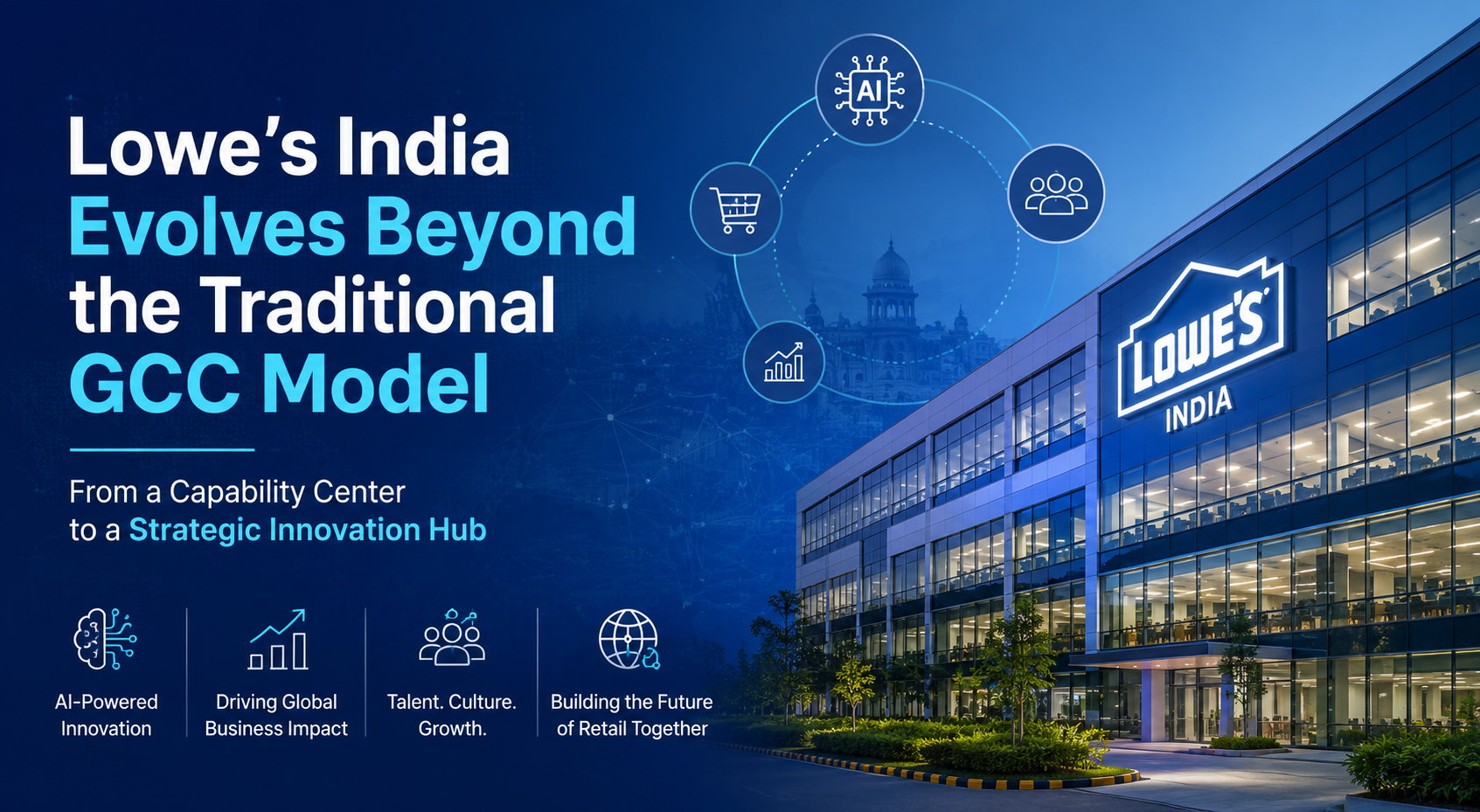
he role of Global Capability Centers (GCCs) in India is undergoing a profound transformation. No longer viewed as cost-efficient back-office operations, leading GCCs are becoming critical drivers of innovation, technology, and enterprise strategy. Lowe’s India is a prime example of this evolution.
The Bengaluru-based center of the US home improvement retail giant is redefining what a GCC can achieve. Rather than functioning solely as a support organization, Lowe’s India is positioning itself as a strategic business partner that influences global product development, digital transformation, AI innovation, and customer experience initiatives across the enterprise.
Moving Beyond the GCC Label
As multinational organizations rethink the purpose of their India operations, Lowe’s India is embracing a broader mission. The company’s leadership views the center not merely as an offshore extension but as an integral part of Lowe’s global growth and innovation strategy.
This shift reflects a larger trend across India’s GCC ecosystem, where centers are increasingly taking ownership of business-critical functions, driving product innovation, and contributing directly to enterprise outcomes rather than simply executing delegated tasks.
For Lowe’s India, the goal is to create an environment where teams build, innovate, and influence decisions that shape the future of retail technology worldwide.
A Technology and Innovation Powerhouse
Over the years, Lowe’s India has expanded its capabilities significantly. The center now supports a wide range of functions, including:
- Enterprise Architecture
- Data Science and Analytics
- Supply Chain Technology
- Merchandising Systems
- Financial Planning and Analytics
- Marketing Technology
- Omnichannel Platforms
- Customer Experience Solutions
These capabilities enable Lowe’s India to contribute across the entire retail value chain, from customer-facing digital experiences to backend operational excellence.
The center’s growing influence demonstrates how GCCs are becoming innovation engines that create measurable business value for global organizations.
AI at the Core of Transformation
Artificial Intelligence has become a major focus area for Lowe’s global operations, and India is playing a central role in this journey.
The company is leveraging AI-driven technologies to enhance customer engagement, optimize supply chains, improve operational efficiency, and support intelligent decision-making across the organization. Lowe’s India teams are actively involved in building and scaling these next-generation capabilities.
As AI continues to reshape the retail industry, the Bengaluru center is expected to remain a key contributor in developing innovative solutions that improve both customer experiences and business outcomes.
Building a Future-Ready Workforce
One of the distinguishing aspects of Lowe’s India is its emphasis on talent development and workplace culture.
The organization is focused on creating an environment where employees can continuously learn, experiment, and grow. By investing in digital skills, leadership development, and emerging technologies, the company aims to prepare its workforce for the future of retail and technology.
This people-first approach aligns with the broader GCC trend where attracting, nurturing, and retaining high-quality talent has become a strategic priority.
Driving Global Impact from India
Lowe’s India’s journey illustrates how GCCs are evolving into centers of excellence that influence global business strategy.
The center is no longer limited to supporting operations; it is helping define new products, modernize platforms, improve customer experiences, and accelerate enterprise-wide innovation. This transformation reflects the growing confidence multinational companies have in India’s talent ecosystem and its ability to deliver high-value strategic outcomes.
The Future of Lowe’s India
As the GCC landscape continues to mature, Lowe’s India is positioning itself at the forefront of the next phase of growth. By combining deep technology expertise, AI-driven innovation, and a strong talent culture, the organization is demonstrating what modern GCCs can become.
Its evolution from a traditional support center to a strategic innovation hub highlights a broader shift taking place across India’s GCC ecosystem—one where centers are increasingly shaping global business decisions, driving digital transformation, and creating long-term competitive advantage for their parent organizations.
Key Takeaway: Lowe’s India is proving that the future of GCCs lies beyond cost optimization. The center is emerging as a strategic partner that drives innovation, AI adoption, talent development, and enterprise transformation on a global scale.
Data Source : Link
Hyderabad, India: Global quality engineering and software testing company TestingXperts has inaugurated a new AI Delivery Centre in Hyderabad, marking a significant step in its strategy to expand AI-led quality engineering services and support the growing demand for intelligent software testing solutions.
The new centre is designed to accelerate the adoption of Artificial Intelligence (AI), Generative AI (GenAI), and intelligent automation across enterprise testing engagements. It will serve as a global hub for developing next-generation testing frameworks that help organizations improve software quality while reducing delivery timelines.
Strengthening AI-Powered Quality Engineering
The Hyderabad AI Delivery Centre will focus on building advanced capabilities in AI-driven test automation, predictive quality engineering, autonomous testing, and intelligent test management. The facility will enable TestingXperts to deliver scalable, technology-enabled testing services for enterprises undergoing digital transformation.
By integrating AI into software quality assurance, the company aims to improve testing accuracy, accelerate release cycles, and enhance customer experiences across industries.
Hyderabad Reinforces Its Position as an AI Innovation Hub
The decision to establish the new delivery centre in Hyderabad highlights the city’s growing importance as a destination for AI innovation and Global Capability Centre (GCC) investments. With access to a highly skilled technology workforce, world-class infrastructure, and a thriving digital ecosystem, Hyderabad continues to attract global organizations expanding their engineering and AI operations.
The new centre is expected to support clients across multiple sectors, including banking, financial services, insurance, healthcare, retail, telecommunications, manufacturing, and technology.
Expanding Global Delivery Capabilities
The AI Delivery Centre will strengthen TestingXperts’ global delivery model by bringing together specialists in artificial intelligence, data engineering, cloud technologies, automation, and quality engineering. The company plans to leverage these capabilities to help enterprises modernize legacy testing processes and accelerate AI adoption across software development lifecycles.
The centre will also support research and innovation initiatives focused on developing proprietary AI-powered testing accelerators and automation platforms.
Supporting Enterprise Digital Transformation
As organizations increasingly embrace cloud-native applications, digital platforms, and AI-driven business models, software quality has become a critical business priority. Traditional testing approaches are no longer sufficient to meet the speed and complexity of modern application development.
TestingXperts’ investment reflects the industry’s broader shift toward AI-first quality engineering, where intelligent automation, predictive analytics, and machine learning are transforming how software is validated and deployed.
India’s Growing Role in AI-Led GCC Expansion
India continues to strengthen its position as a global hub for AI, engineering, and digital transformation. Companies are increasingly investing in specialized delivery centres that go beyond traditional IT services to focus on innovation, product engineering, and enterprise AI.
TestingXperts’ latest expansion reinforces this trend, demonstrating how organizations are leveraging India’s talent ecosystem to build advanced capabilities that support global customers.
Looking Ahead
The launch of the AI Delivery Centre in Hyderabad represents an important milestone in TestingXperts’ growth strategy. By investing in AI-powered quality engineering and intelligent automation, the company is positioning itself to help enterprises deliver faster, more reliable, and higher-quality digital products.
As demand for AI-enabled software testing continues to rise, the new centre is expected to play a pivotal role in driving innovation, accelerating digital transformation, and strengthening TestingXperts’ global delivery capabilities.
Data Source : Link
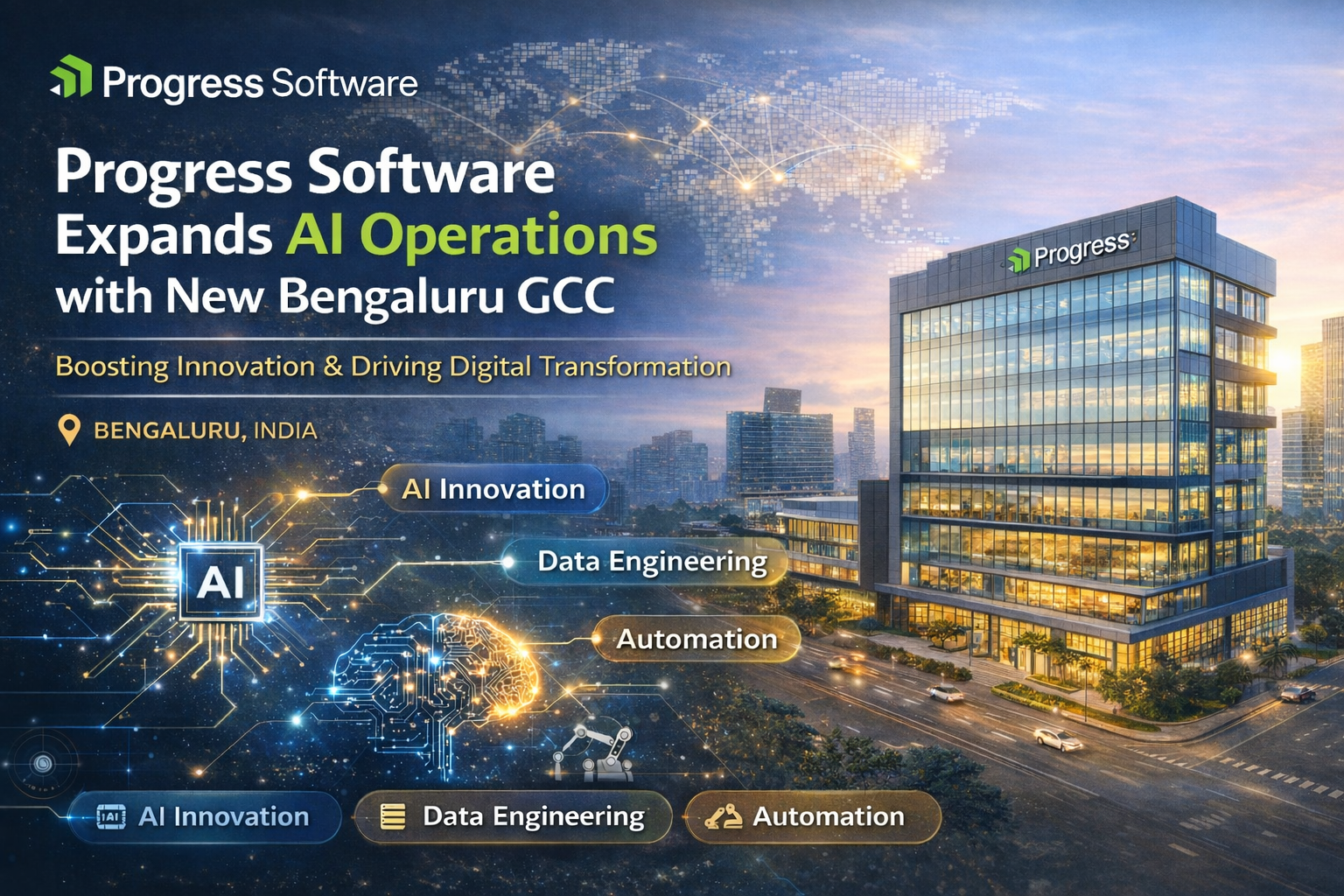
Global enterprises are no longer viewing Global Capability Centers (GCCs) as just operational backbones—they are now becoming strategic engines for innovation. Reinforcing this shift, Progress Software has announced the expansion of its footprint in Bengaluru with a new Global Capability Center (GCC) focused on advancing AI-driven operations.
This move underscores a growing trend: multinational companies are increasingly leveraging India’s deep technology talent pool to accelerate digital transformation initiatives.
Strengthening AI-Led Operations
The new GCC will play a critical role in enhancing Progress Software’s artificial intelligence (AI) capabilities. Rather than functioning as a traditional support center, the Bengaluru hub is designed to lead innovation across areas such as:
- AI-powered product development
- Cloud-based enterprise solutions
- Data engineering and analytics
- Automation and intelligent workflows
By embedding AI at the core of its operations, Progress Software is aiming to deliver faster, smarter, and more scalable solutions to its global customer base.
Why Bengaluru Continues to Attract Global GCC Investments
Bengaluru has firmly established itself as a global GCC hotspot. The city offers a unique combination of:
- Highly skilled engineering and AI talent
- Mature startup and innovation ecosystem
- Strong infrastructure for global operations
- Proven track record in delivering high-value R&D
For companies like Progress Software, setting up or expanding a GCC in Bengaluru is not just about cost efficiency—it’s about accessing innovation at scale.
GCCs Evolving into Innovation Hubs
The expansion of Progress Software’s GCC reflects a broader industry evolution. Today’s GCCs are:
- Driving product innovation rather than just supporting it
- Leading AI and digital transformation initiatives
- Acting as strategic extensions of global headquarters
- Contributing directly to revenue and business growth
This transition marks a shift from “offshore delivery centers” to “global innovation hubs.”
Talent as the Core Differentiator
At the heart of this expansion is talent. The Bengaluru GCC will bring together engineers, data scientists, and AI specialists to collaborate on next-generation solutions.
The focus is not just on hiring—but on building high-performance teams that can:
- Experiment with emerging technologies
- Scale AI use cases across business functions
- Deliver measurable business outcomes
What This Means for the Future of GCCs
Progress Software’s investment signals a clear direction for the future:
- AI will be central to GCC strategies
- India will remain a key global innovation destination
- GCCs will continue to move up the value chain
- Enterprises will rely on GCCs for competitive advantage
As more organizations follow this model, GCCs will increasingly become the driving force behind enterprise transformation.
Conclusion
The launch of Progress Software’s new GCC in Bengaluru is more than an expansion—it’s a strategic move toward AI-first operations and global innovation.
For the GCC ecosystem, this is another strong validation that the future lies in intelligence, agility, and innovation-driven delivery models.
-

 Business6 months ago
S&P Global Expands India Footprint with New Gurugram Hub
-

 Bengaluru7 months ago
Abercrombie & Fitch Enters India’s GCC Landscape with Bengaluru Launch
-

 Bengaluru6 months ago
Commonwealth Bank Appoints Shubha Iyer as CEO of CommBank India to Strengthen GCC and Digital Transformation Strategy
-
 Politics7 months ago
Maximus Expands Hyderabad GCC: Strengthening India’s Role in Global Healthcare & Public Sector Operations
-

 Press Release6 months ago
KnowVisory Global Launches Payroll Processing and Administration Services to Simplify Compliance for Growing Businesses
-

 Bengaluru3 months ago
DePuy Synthes Selects Bengaluru for New GCC, Targets 500 Hires
-
 New GCC4 months ago
Generac Launches First India Global Capability Center in Pune
-

 Business7 months ago
GCC in Coimbatore: Why It’s the Next Big Hub for Global Capability Centers