Business
Workday’s Chennai GCC: A Strategic Bet on India’s Talent and Scale

Global enterprise software company Workday is making a significant move in India’s GCC landscape — and Chennai is at the center of it.
By signing one of the largest enterprise office deals in the city, Workday is not just expanding its footprint — it is reinforcing a larger trend: India as a global operations and innovation hub.
A Large-Scale GCC Commitment
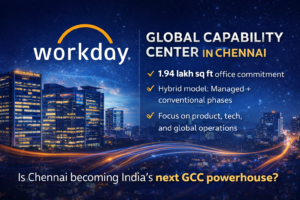
Workday has leased approximately 1.94 lakh sq. ft. of office space in Chennai, marking one of the most substantial single-occupier office commitments in recent times.
The facility, located in Millenia Business Park (Perungudi), is being developed in partnership with CoWrks and backed by Brookfield Properties.
This is not a small expansion — the scale clearly indicates a long-term, strategic GCC setup rather than a satellite office.
A Phased, Scalable Expansion Model
The GCC rollout is structured in two phases, combining flexibility with long-term planning:
- Phase 1: Managed office space (~1 lakh sq. ft.) for quick operational readiness
- Phase 2: Conventional leased space (~94,000 sq. ft.) for customized build-out
This hybrid model allows Workday to:
- Start operations quickly
- Scale infrastructure gradually
- Optimize costs and workspace design
It reflects a new-age GCC strategy — agile, modular, and scalable.
More Than Real Estate — A Strategic Hub
While Workday hasn’t disclosed full operational details, the size and nature of the investment suggest the GCC will likely support:
- Product development
- Engineering and technology functions
- Global service delivery
Industry benchmarks indicate such a facility could accommodate 1,500 to 2,500 professionals, making it a major operational hub.

Why Chennai?
Workday’s choice of Chennai is not accidental.
The city is rapidly emerging as a preferred GCC destination due to:
- Strong engineering and tech talent pool
- Mature IT infrastructure (especially OMR corridor)
- Competitive operating costs compared to other metros
- Supportive state policies and incentives
Chennai is no longer a secondary option — it is becoming a frontline GCC hub.
What This Means for India’s GCC Ecosystem
Workday’s move reflects broader macro trends:
1. GCCs are driving commercial real estate demand
Large-format office deals are returning, led by tech-driven global companies.
2. Hybrid work isn’t reducing office investments
Instead, companies are investing in high-quality, scalable workspaces.
3. India’s role is expanding beyond cost advantage
The focus is now on talent, innovation, and global capability building.
4. Chennai is rising as a GCC powerhouse
The city is competing directly with Bengaluru and Hyderabad for large-scale GCC investments.
Final Take
Workday’s Chennai GCC is not just an office deal — it’s a signal of where global business is heading.
Large, strategic GCCs…
Built in talent-rich markets…
Designed for scale, innovation, and long-term impact.
The shift is clear:
GCCs are no longer support centers.
They are becoming core to how global companies build, operate, and grow.
Data Source : link