
Hyderabad
Redwood Software Strengthens India Bet with New Tech Centre in Hyderabad

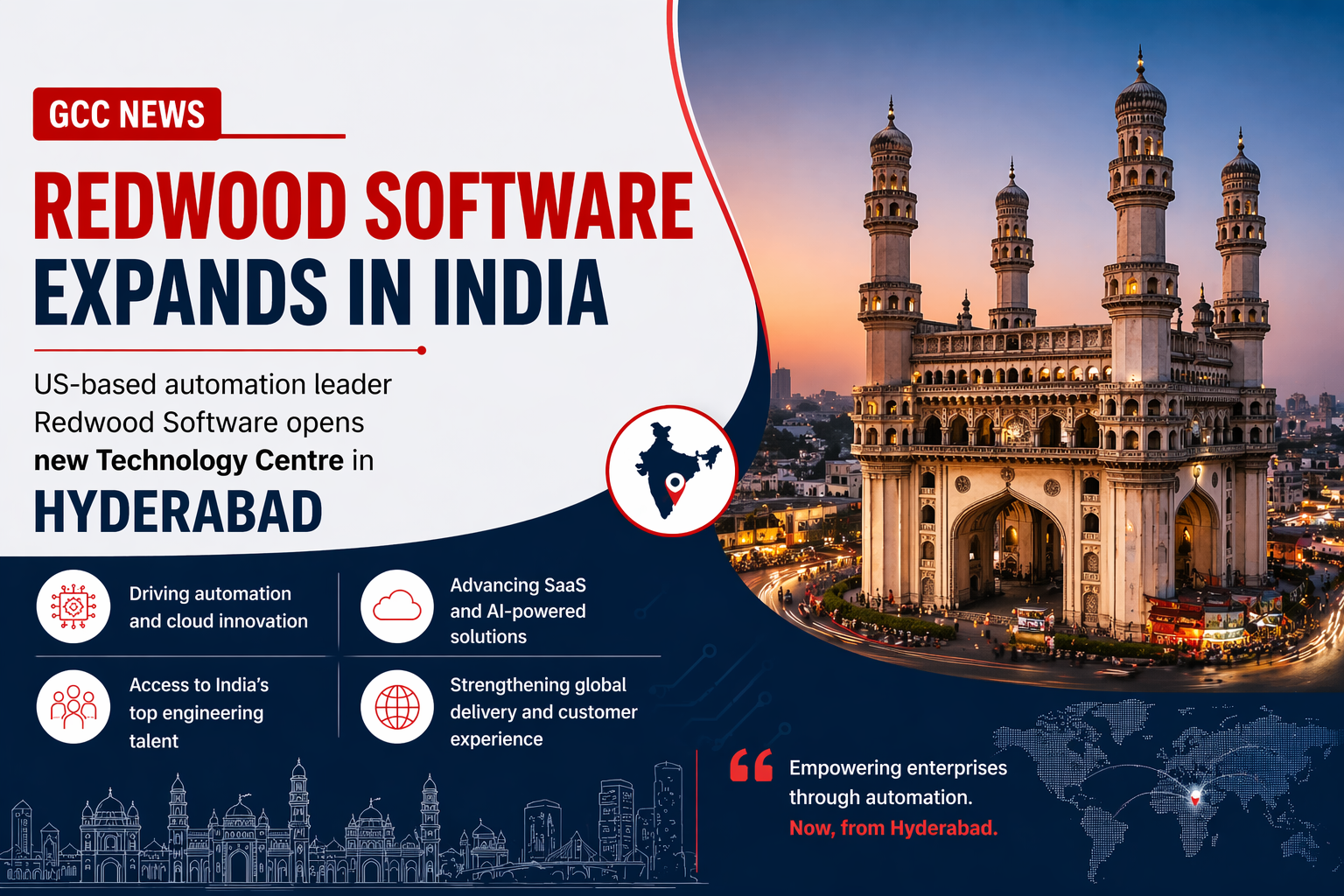
Global automation leader Redwood Software has expanded its international footprint by launching a new technology centre in Hyderabad, reinforcing India’s position as a strategic hub for Global Capability Centers (GCCs).
A Strategic Move into India’s GCC Ecosystem
The newly established centre in Hyderabad marks a significant milestone in Redwood Software’s global expansion strategy. The company aims to leverage India’s deep talent pool in software engineering, automation, and enterprise technology to accelerate innovation and deliver scalable solutions to global clients.
Hyderabad continues to emerge as a preferred destination for multinational corporations building GCCs, thanks to its mature IT ecosystem, strong infrastructure, and access to highly skilled professionals. Redwood’s entry further validates the city’s growing prominence in the global tech landscape.
Focus on Automation and Cloud Innovation
Redwood Software specializes in automation solutions that streamline enterprise operations, particularly in areas such as finance, IT, and business process automation. The Hyderabad centre will play a critical role in advancing the company’s cloud-native automation platform and enhancing product development capabilities.
The facility is expected to support:
- Advanced product engineering
- Cloud and SaaS innovation
- AI-driven automation development
- Global customer support and delivery
This aligns with the broader trend of GCCs evolving beyond support functions into high-value innovation and R&D hubs.
Talent-Led Expansion Strategy
India remains central to Redwood’s growth roadmap due to its strong engineering talent base. The Hyderabad centre will focus on hiring skilled professionals across software development, DevOps, data engineering, and enterprise automation domains.
This move reflects a larger shift among global firms—from cost arbitrage to capability-driven investments—where GCCs are built to drive innovation, not just efficiency.
Strengthening Global Delivery Capabilities
With this new centre, Redwood Software aims to enhance its ability to deliver seamless, round-the-clock services to its global customer base. The India team will collaborate closely with international counterparts, ensuring faster deployment cycles and improved customer experience.
The expansion also enables Redwood to scale its operations efficiently while maintaining agility in product innovation and service delivery.
Hyderabad’s Growing GCC Momentum
Hyderabad has steadily attracted global enterprises setting up GCCs across sectors such as fintech, healthcare, SaaS, and manufacturing. Factors contributing to this growth include:
- Strong government support and policies
- World-class IT infrastructure
- Competitive operating costs
- A thriving startup and innovation ecosystem
Redwood Software’s investment adds to this momentum, positioning the city as a critical node in the global automation and enterprise technology network.
What This Means for the GCC Landscape
Redwood’s Hyderabad centre highlights a key evolution in the GCC model:
- From back-office operations to innovation hubs
- From cost centers to strategic value creators
- From local execution to global product ownership
As more companies follow this path, India’s GCC ecosystem is set to play an even larger role in shaping global technology and digital transformation initiatives.
Source : Link
Hyderabad
Syneos Health Opens New Hyderabad Facility, Strengthening Its AI and Life Sciences GCC Strategy
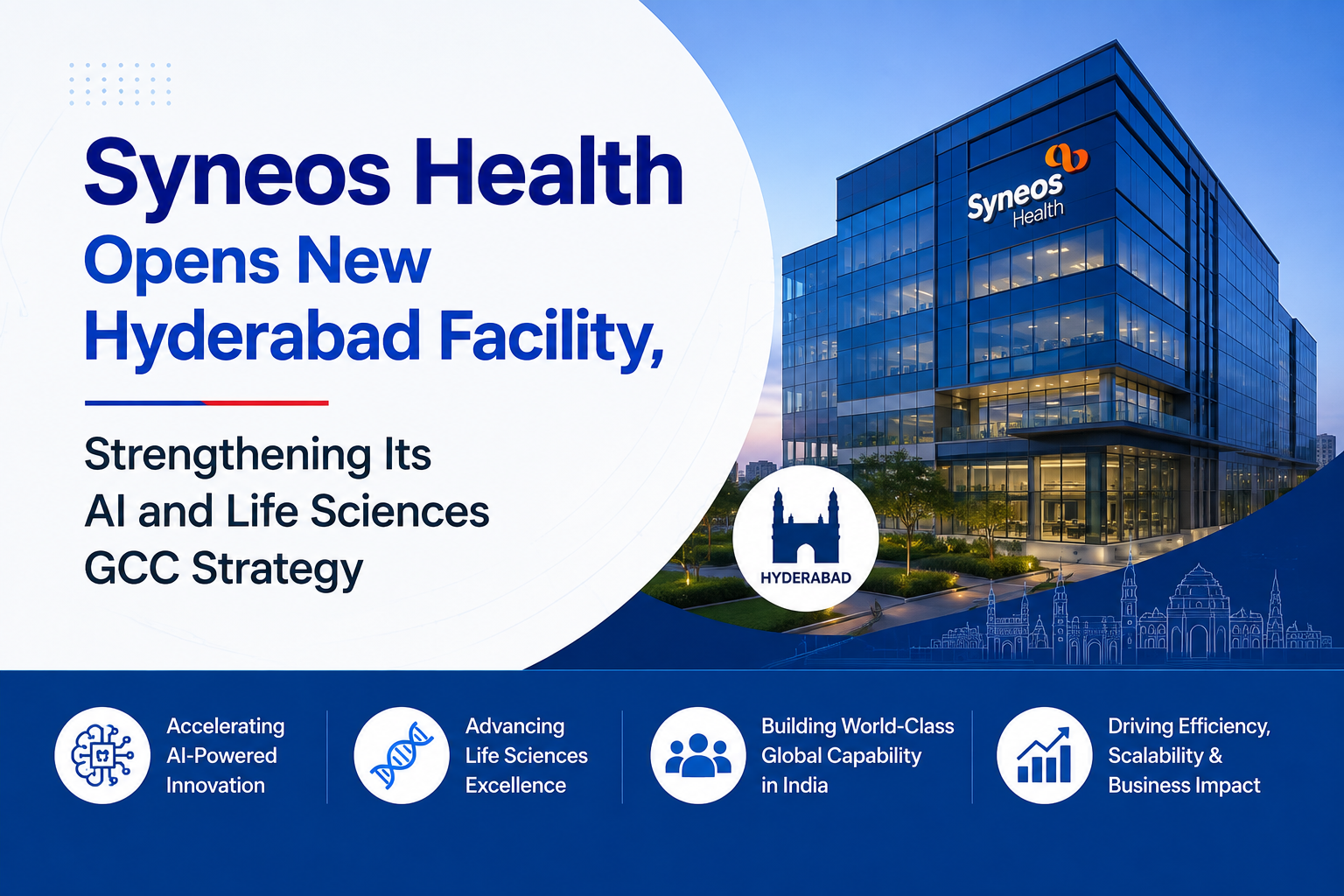
Hyderabad is strengthening its position as a strategic destination for global life sciences and healthcare technology operations, with Syneos Health opening a new facility at Phoenix Equinox in Gachibowli.
The new centre is significant not only because of its scale, but also because of its mandate. Syneos Health is positioning the Hyderabad facility as a strategic hub for artificial intelligence, data and technology, bringing together scientific expertise, biopharmaceutical knowledge and engineering capabilities to support the development, safety and commercialisation of therapies.
Hyderabad Facility Becomes a Major Global Hub
The new Hyderabad centre is described as Syneos Health’s largest facility in Asia and its third-largest globally. The expansion reinforces the company’s growing presence in a city that has developed a strong ecosystem spanning pharmaceuticals, biotechnology, clinical research, healthcare technology and advanced analytics.
Headquartered in Morrisville, North Carolina, Syneos Health has a global workforce of more than 26,000 people and provides services across the biopharmaceutical lifecycle, including clinical development, medical affairs and commercialisation.
The company’s existing Hyderabad presence has been based at Raheja Mindspace in HITEC City. The new Gachibowli facility adds another strategic dimension to its operations in India.
From Traditional GCC to AI-Powered Healthcare Innovation
The most important aspect of the expansion is the role being assigned to the Hyderabad hub.
Rather than operating primarily as a conventional shared-services centre, Syneos Health is building the location around AI, data and technology excellence. The objective is to combine technology capabilities with domain expertise in clinical development, patient safety and commercialisation.
This reflects a broader transformation taking place across India’s GCC ecosystem. Global organisations are increasingly establishing specialised teams in areas such as:
- Generative AI
- Data engineering
- Advanced analytics
- Machine learning
- Clinical technology
- AI product development
- Responsible AI and compliance
- Digital transformation
The shift signals a move away from the traditional cost-arbitrage model toward high-value, knowledge-intensive GCC operations.
AI at the Centre of the Hyderabad Strategy
Syneos Health’s Hyderabad AI Hub is designed to support the application of AI across clinical development, safety and commercialisation.
The company describes the hub as a place where AI capabilities work alongside clinicians, safety scientists and commercial specialists. Its stated focus includes building technology that can address real-world healthcare and biopharmaceutical challenges rather than treating AI as an isolated experimentation function.
The organisation is also building capabilities across the AI and data lifecycle, including GenAI engineering, prompt specialisation, MLOps, data engineering, data science, AI product management, responsible AI, quality engineering and enterprise architecture.
This combination of domain expertise + technology + AI could become one of the defining characteristics of the new Hyderabad operation.
Creating a New Talent Model for Life Sciences
The expansion also highlights the changing talent requirements within healthcare-focused GCCs.
Syneos Health’s current Hyderabad hiring pipeline includes roles across safety and pharmacovigilance, data, technology, quality, cybersecurity, clinical programming and transformation. Its careers portal currently lists multiple Hyderabad opportunities, including Safety & PV Specialists, Validation & QA Analysts, QA Testers, Senior Transformation Analysts and Cyber Resiliency professionals.
The company’s broader Hyderabad AI strategy is expected to require professionals who can operate at the intersection of technology and life sciences.
This creates demand for a new category of talent: professionals who understand not only AI and data engineering, but also the regulatory, scientific and operational requirements of healthcare.
Why This Matters for Hyderabad’s GCC Ecosystem
Syneos Health’s investment adds another important dimension to Hyderabad’s GCC story.
The city has traditionally been recognised for its IT and pharmaceutical strengths. Increasingly, however, these two ecosystems are converging.
Healthcare companies can now tap into:
Pharmaceutical expertise + clinical research + engineering talent + AI capabilities + advanced analytics
That combination makes Hyderabad increasingly attractive for global organisations looking to build specialised healthcare technology and innovation centres.
Syneos Health’s new facility is therefore more than an office expansion. It represents the emergence of life sciences GCCs as technology and innovation engines.
The Bigger GCC Trend
The Syneos Health expansion reflects a broader change in how multinational companies are approaching their India operations.
Earlier generations of GCCs were often established around finance, IT support, customer operations and other shared services. Today’s centres are increasingly being designed around product engineering, AI, analytics, R&D, digital transformation and strategic decision support.
The healthcare sector is particularly suited to this evolution because AI and advanced analytics can be applied across complex workflows—from clinical development and safety monitoring to commercial strategy.
For companies such as Syneos Health, India offers access to both the technology talent required to build these capabilities and the scientific expertise needed to apply them responsibly.
A Strategic Milestone for Syneos Health and Hyderabad
The opening of Syneos Health’s new Hyderabad facility comes at a time when the company is accelerating its AI strategy globally. Syneos Health recently highlighted efforts to advance AI-powered clinical capabilities and improve decision-making across its biopharmaceutical services.
Against this backdrop, Hyderabad’s role becomes increasingly strategic.
The new centre demonstrates how a GCC can evolve from a delivery location into a global capability and innovation hub, with responsibility for technology, data, AI and domain-specific transformation.
For Hyderabad, it strengthens the city’s position as one of India’s leading destinations for life sciences-driven GCC growth.
For Syneos Health, it provides a platform to bring together AI, engineering and biopharmaceutical expertise to accelerate the journey from scientific discovery to patient impact.
GCC Lens Take
Syneos Health’s Hyderabad expansion is a strong example of the next generation of GCCs—where the objective is no longer simply to deliver services from India, but to build specialised capabilities that directly influence global business outcomes.
The combination of AI, data, engineering and life sciences expertise could make the Hyderabad hub an important part of Syneos Health’s global innovation strategy.
As more healthcare and pharmaceutical companies follow a similar path, Hyderabad’s GCC ecosystem could increasingly evolve into a global centre for AI-powered healthcare innovation.
Hyderabad
Charles Schwab Enters India with Hyderabad Technology Centre, Targets 2,000 Employees by 2027
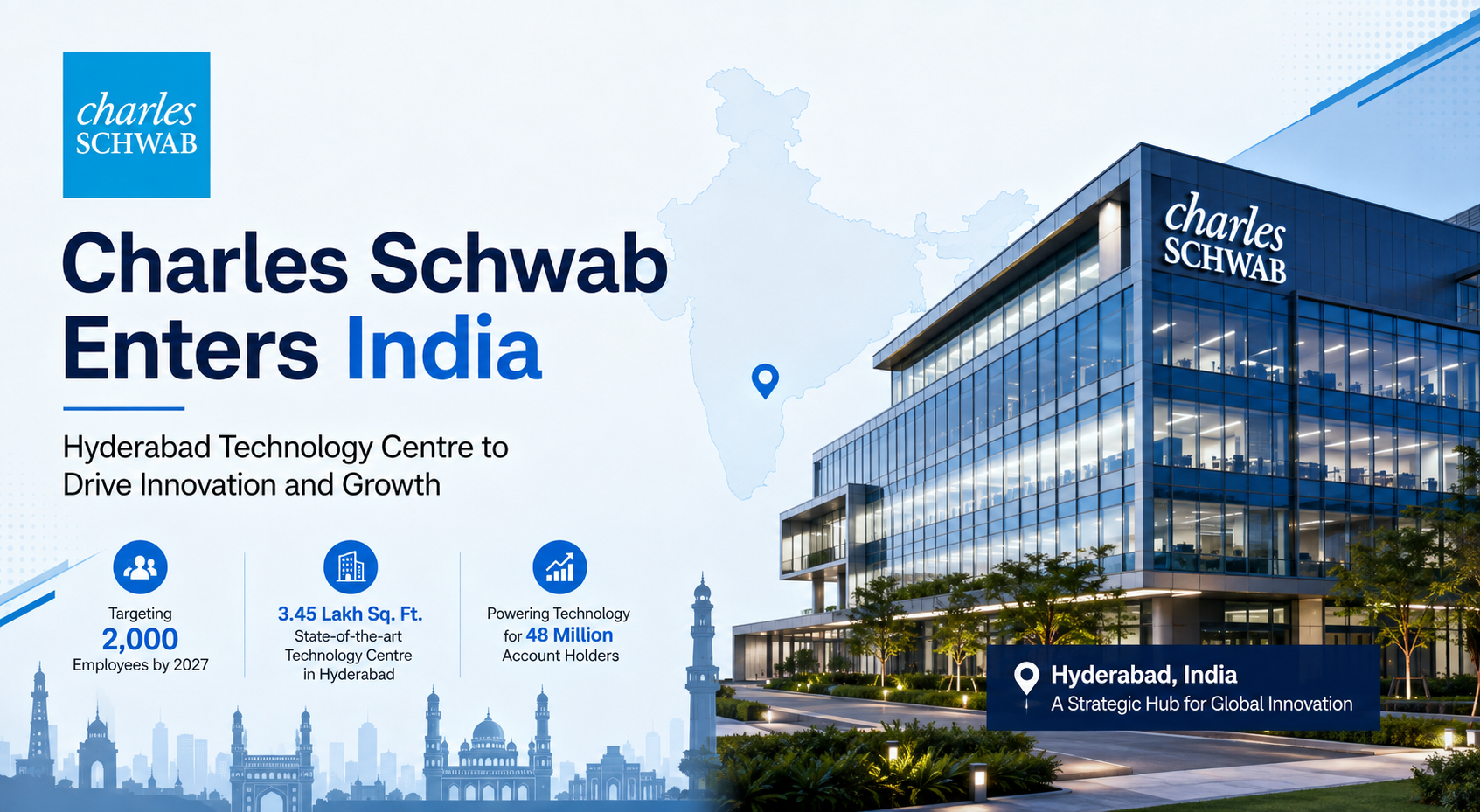
Charles Schwab has officially expanded its global technology footprint into India with the opening of a 3.45 lakh sq. ft. technology capability centre in Hyderabad. The move marks a significant milestone for the US-based financial services company and reinforces Hyderabad’s growing position as a strategic destination for global financial technology and Global Capability Centres (GCCs).
The new centre is designed to support Charles Schwab’s US business through technology development, engineering and operational capabilities. The company plans to scale its India workforce to approximately 2,000 employees by the end of 2027, making the Hyderabad operation a potentially important technology hub within Schwab’s global network.
From Technology Centre to Strategic GCC
Charles Schwab’s India journey has been in the making for several years. In August 2024, the company identified Hyderabad as the prospective location for its first Technology Development Centre in India following discussions with the Telangana government and senior Schwab executives.
The centre has now moved from the planning stage to a full-scale technology capability operation. Rather than functioning simply as an offshore delivery unit, Schwab India is expected to contribute directly to the design, development and delivery of technology solutions supporting millions of Schwab clients in the United States.
This reflects the broader evolution of financial-services GCCs in India—from cost-focused support centres toward engineering-led organisations responsible for critical technology, platforms and business capabilities.
Hyderabad Emerges as a Capital Markets Technology Hub
Charles Schwab’s decision further strengthens Hyderabad’s credentials as a financial technology destination.
The city already hosts major global financial institutions, including Deutsche Börse, Vanguard, JPMorgan Chase and Goldman Sachs, creating an ecosystem spanning capital markets, brokerage, trading, wealth management and fintech.
The expansion also comes as Hyderabad continues to attract financial-services GCCs. According to the ETGCC report, BFSI accounts for more than a third of GCC demand in the city.
For Schwab, this ecosystem provides access to a mature technology talent pool and infrastructure while enabling the company to build deeper in-house engineering capabilities.
Bringing Technology Capabilities In-House
One of the notable aspects of Schwab’s India strategy is its intention to bring selected technology capabilities currently supported by contractors in India into its own Hyderabad operations.
This indicates a shift from a traditional vendor-led delivery model toward direct ownership of technology capabilities.
The strategy can provide Schwab with greater control over engineering quality, intellectual property, technology architecture and delivery speed. Christopher Wyse, Managing Director and Chief Corporate Affairs Officer at Charles Schwab, said direct investment in engineering talent in India would enable the company to build with greater speed and quality.
This is increasingly becoming a defining characteristic of modern GCCs: companies are not merely moving work to India—they are building permanent technology capabilities and strategic expertise there.
Supporting 48 Million Account Holders
The scale of Schwab’s global business adds significance to the Hyderabad centre.
The company said its India operation will strengthen its ability to serve approximately 48 million account holders and around 30,000 employees who depend on Schwab’s technology every day.
That puts the Hyderabad centre much closer to the core of Schwab’s technology ecosystem rather than positioning it as a peripheral support operation.
The India team will have opportunities to work across multiple technology domains while contributing to platforms and solutions used by Schwab’s global customer base.
AI and the Next Wave of Financial Technology
The expansion comes at a time when the financial-services industry is rapidly integrating artificial intelligence and automation into technology and operations.
For Hyderabad, the opportunity extends beyond conventional software development. The city’s growing financial ecosystem could support capabilities in areas such as AI-powered investment research, risk modelling, fraud detection and regulatory technology.
Charles Schwab’s presence therefore adds another major financial institution to an ecosystem that could increasingly become a centre for next-generation capital markets technology.
The broader trend is also visible across India’s financial-services GCC landscape. Global financial institutions are increasingly establishing or expanding technology centres in India to access engineering, risk, operations and AI talent at scale.
What Schwab’s India Expansion Signals for GCCs
Charles Schwab’s Hyderabad investment highlights several important trends shaping India’s GCC market.
1. GCCs are becoming engineering-led.
The focus is shifting from back-office support toward software engineering, architecture, data, cybersecurity, AI and product development.
2. Financial services is becoming increasingly technology-driven.
Capital markets firms need sophisticated technology capabilities, and India is increasingly being used to build those capabilities rather than simply operate them.
3. Companies are bringing strategic work in-house.
Schwab’s plan to internalise selected contractor-supported technology capabilities demonstrates the growing importance of direct talent ownership.
4. Hyderabad is strengthening its BFSI technology proposition.
The concentration of global financial institutions is creating an ecosystem where talent, technology companies, fintechs, universities and financial firms can collaborate.
5. GCC scale is moving beyond traditional cost optimisation.
The objective is increasingly speed, innovation, engineering quality and access to specialised talent.
Hyderabad’s GCC Story Gets Stronger
Charles Schwab’s entry is another important addition to Hyderabad’s expanding GCC landscape. The centre combines a substantial physical footprint, a long-term hiring strategy and a technology mandate tied directly to the company’s global business.
The planned expansion to around 2,000 employees by the end of 2027 also suggests that Schwab views India as a long-term strategic technology location rather than a short-term delivery destination.
For Hyderabad, the opportunity is equally significant. As more global financial institutions establish engineering and technology operations in the city, the ecosystem could evolve from being a major GCC market into a global hub for capital markets technology and wealthtech.
Charles Schwab’s India entry is therefore more than the launch of another technology centre. It is a sign of how global financial institutions are increasingly building core technology capabilities in India—and how Hyderabad is positioning itself at the centre of that transformation.
Data Source : Link
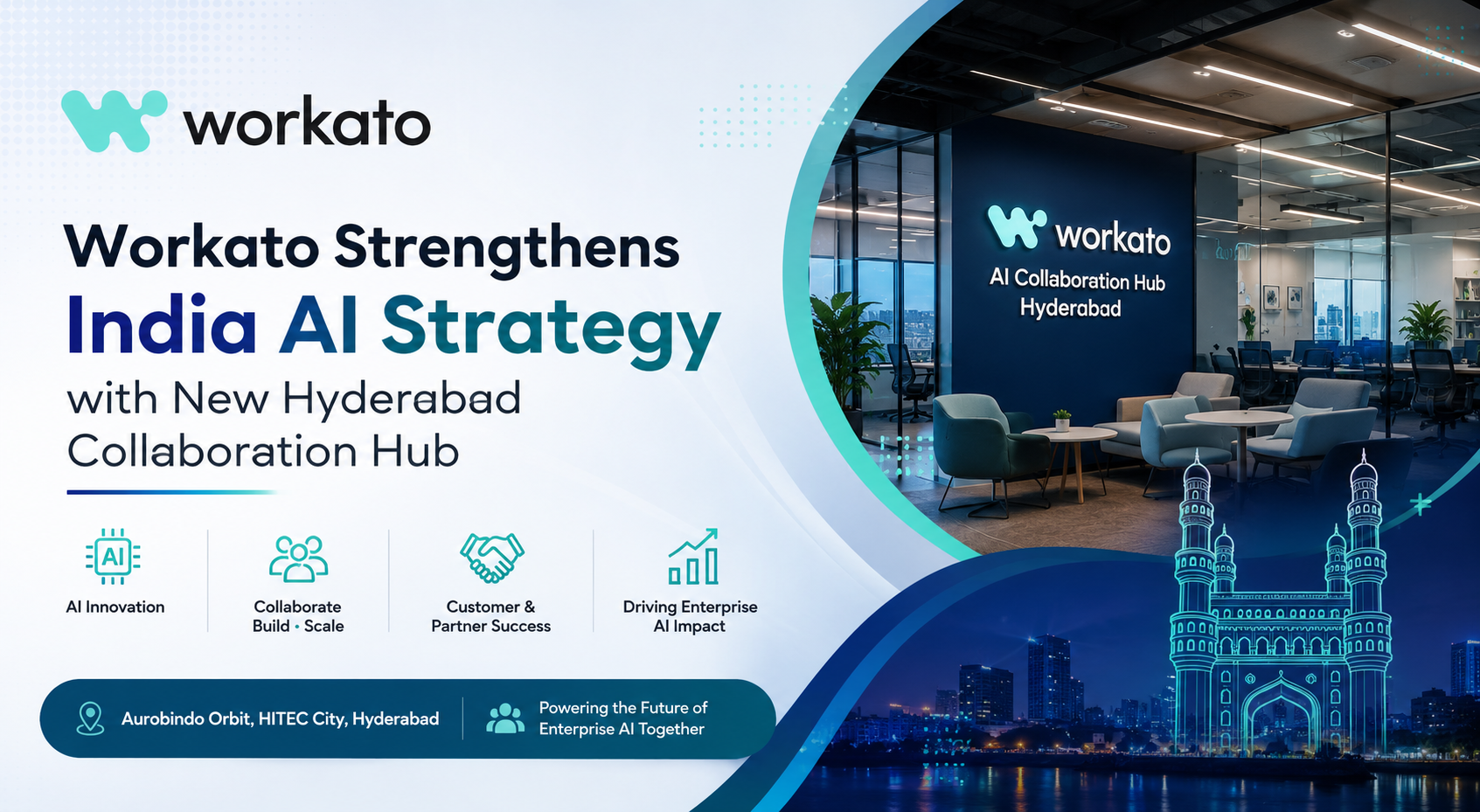
Cloud-based integration and automation platform Workato has expanded its presence in India with the launch of a new AI Collaboration Hub in Hyderabad. The facility marks the company’s third global AI Collaboration Hub, joining its existing centers in San Francisco and Singapore, and reinforces India’s growing role in the global enterprise AI ecosystem.
Located at Aurobindo Orbit in Hyderabad Knowledge City, HITEC City, the new hub is designed to bring together customers, global system integrator (GSI) partners, developers, and Workato engineers under one roof to co-create and deploy enterprise-grade AI solutions. The initiative reflects a growing industry shift from AI experimentation to practical, production-ready implementation.
A Hub Built for Enterprise AI Innovation
Unlike traditional innovation centers, Workato’s Hyderabad facility has been established as a hands-on collaboration environment where organizations can rapidly design, test, and deploy agentic AI solutions. The hub features dedicated collaboration zones, hot-desking facilities, and build labs that enable teams to move from concept to working AI-powered workflows in a matter of days.
The company believes that successful enterprise AI adoption requires more than advanced models. Organizations must also address integration challenges, governance requirements, legacy systems, and operational scalability. By creating a space where customers and partners can work directly with Workato’s engineering teams, the company aims to accelerate AI deployment and business value realization.
Hyderabad Emerges as a Strategic AI Destination
The decision to establish the hub in Hyderabad highlights the city’s growing reputation as one of India’s leading technology and AI centers. With a strong talent pool, thriving startup ecosystem, and presence of global technology companies, Hyderabad has become a preferred destination for organizations building advanced digital and AI capabilities.
India’s importance in the global AI landscape continues to grow. The country has emerged as one of the world’s largest contributors to AI development, supported by a vast engineering workforce and increasing participation in global AI innovation. This environment makes Hyderabad an attractive location for companies seeking expertise in AI, enterprise architecture, automation, and digital transformation.
Workato’s Growing India Footprint
Since launching operations in India in 2022, Workato has steadily expanded its presence across Hyderabad, Bengaluru, and Chennai. The company now employs more than 200 professionals in the country, with India playing an increasingly significant role in its global engineering and AI roadmap.
The new Hyderabad facility represents a deeper investment in the region and demonstrates Workato’s confidence in India’s ability to support next-generation AI innovation. Beyond serving as an engineering center, the hub is expected to become a platform for customer engagement, partner collaboration, and solution development.
Driving Faster Enterprise AI Adoption
One of the major barriers to enterprise AI success is the gap between pilot projects and production deployment. Many organizations struggle to connect AI systems with complex enterprise environments, including legacy applications, data infrastructure, and compliance frameworks.
Workato’s collaboration model seeks to address these challenges by enabling customers and partners to work directly alongside the company’s experts. This approach helps organizations develop practical AI solutions that can be integrated into real business processes rather than remaining confined to experimental environments.
For consulting firms and system integrators, the hub also offers opportunities to co-develop industry-specific AI solutions, build repeatable frameworks, and accelerate go-to-market strategies for enterprise clients.
What This Means for India’s GCC Ecosystem
The launch of Workato’s AI Collaboration Hub further strengthens Hyderabad’s position as a global capability center destination for advanced technology functions. While traditional GCCs focused on support and operational activities, the next generation of centers is increasingly centered around AI, product engineering, automation, and innovation.
Workato’s investment reflects a broader trend among global technology companies that are leveraging India not only for talent access but also for strategic innovation and product development. As enterprises worldwide accelerate AI adoption, India’s GCC ecosystem is expected to play an even greater role in shaping the future of enterprise technology.
Looking Ahead
The opening of Workato’s Hyderabad AI Collaboration Hub underscores the company’s commitment to enterprise AI innovation and highlights India’s growing influence in the global technology landscape. By creating an environment where customers, partners, and engineers can collaborate in real time, Workato aims to bridge the gap between AI ambition and business outcomes.
As AI moves from experimentation to enterprise-scale deployment, facilities such as this are likely to become critical enablers of innovation, positioning Hyderabad and India at the forefront of the next wave of digital transformation.
Data Source : Link
-
 Press Release4 months ago
KnowVisory Global Launches Payroll Processing and Administration Services to Simplify Compliance for Growing Businesses
-
 Politics5 months ago
Maximus Expands Hyderabad GCC: Strengthening India’s Role in Global Healthcare & Public Sector Operations
-

 Business5 months ago
GCC in Coimbatore: Why It’s the Next Big Hub for Global Capability Centers
-
 BFSI5 months ago
How Deutsche Bank Is Turning Its India GCC into an AI Innovation Engine
-
 Tech5 months ago
How Revolut Is Turning India Into Its Global GCC Powerhouse
-

 BFSI5 months ago
OwnGCC Launches to Help Global Enterprises Build and Scale High-Impact GCCs in Just 90 Days
-
 Bengaluru4 months ago
Commonwealth Bank Appoints Shubha Iyer as CEO of CommBank India to Strengthen GCC and Digital Transformation Strategy
-

 Bengaluru5 months ago
Abercrombie & Fitch Enters India’s GCC Landscape with Bengaluru Launch