
Hyderabad
Protolabs Launches Global Capability Centre in Hyderabad: Strengthening Digital Manufacturing from India


The expansion of Global Capability Centers (GCCs) in India continues to gain momentum, and the latest move by Protolabs reinforces this trend. By establishing a new Global Capability Centre in Hyderabad, the digital manufacturing leader is doubling down on India’s growing importance as a hub for engineering excellence, innovation, and scalable global operations.
A Strategic Move into India’s GCC Ecosystem
Protolabs’ decision to set up its GCC in Hyderabad is not incidental—it’s strategic. India has evolved from being a cost-arbitrage destination to a value-driven innovation hub. With a strong talent pool in engineering, product development, and digital technologies, Hyderabad offers the right ecosystem for companies aiming to build high-impact global teams.
This new GCC is expected to play a central role in supporting Protolabs’ global operations, particularly across engineering, software development, and business process optimization. It signals a shift from traditional back-office support to high-value, innovation-led capabilities.

Focus on Engineering and Digital Innovation
At its core, Protolabs operates at the intersection of manufacturing and technology. The Hyderabad GCC will strengthen its ability to deliver rapid prototyping and on-demand production solutions at scale.
Key focus areas of the center include:
- Advanced software engineering and platform development
- Automation and process optimization
- Data-driven decision-making and analytics
- Enhancing customer experience through digital tools
This aligns with a broader GCC evolution—where centers are no longer just execution arms but innovation engines contributing directly to global business strategy.
Why Hyderabad?
Hyderabad continues to emerge as one of India’s most preferred GCC destinations. The city offers:
- A deep pool of engineering and tech talent
- Strong infrastructure and connectivity
- A thriving ecosystem of global enterprises and startups
- Favorable policy support from the state government
For Protolabs, this means faster scaling, access to niche skill sets, and the ability to integrate seamlessly with global teams.
Implications for the GCC Landscape
Protolabs’ entry adds to the growing list of global organizations investing in India’s GCC ecosystem. More importantly, it highlights three key shifts:
- From Cost Efficiency to Capability Building
Companies are now leveraging GCCs to build core competencies rather than just reduce operational costs. - Engineering-Led GCC Growth
There is a rising demand for deep-tech talent, particularly in product engineering and digital manufacturing. - India as a Strategic Innovation Hub
GCCs in India are increasingly influencing global product roadmaps and business decisions.
The Road Ahead
As Protolabs scales its Hyderabad operations, the GCC is expected to become a critical node in its global delivery network. Beyond operational efficiency, it will likely drive innovation in digital manufacturing—an area that is rapidly transforming industries worldwide.
For the GCC ecosystem, this move is another validation of India’s position as a global powerhouse for capability centers. And for Hyderabad, it further cements its reputation as a destination of choice for next-generation GCCs.
Source : Link
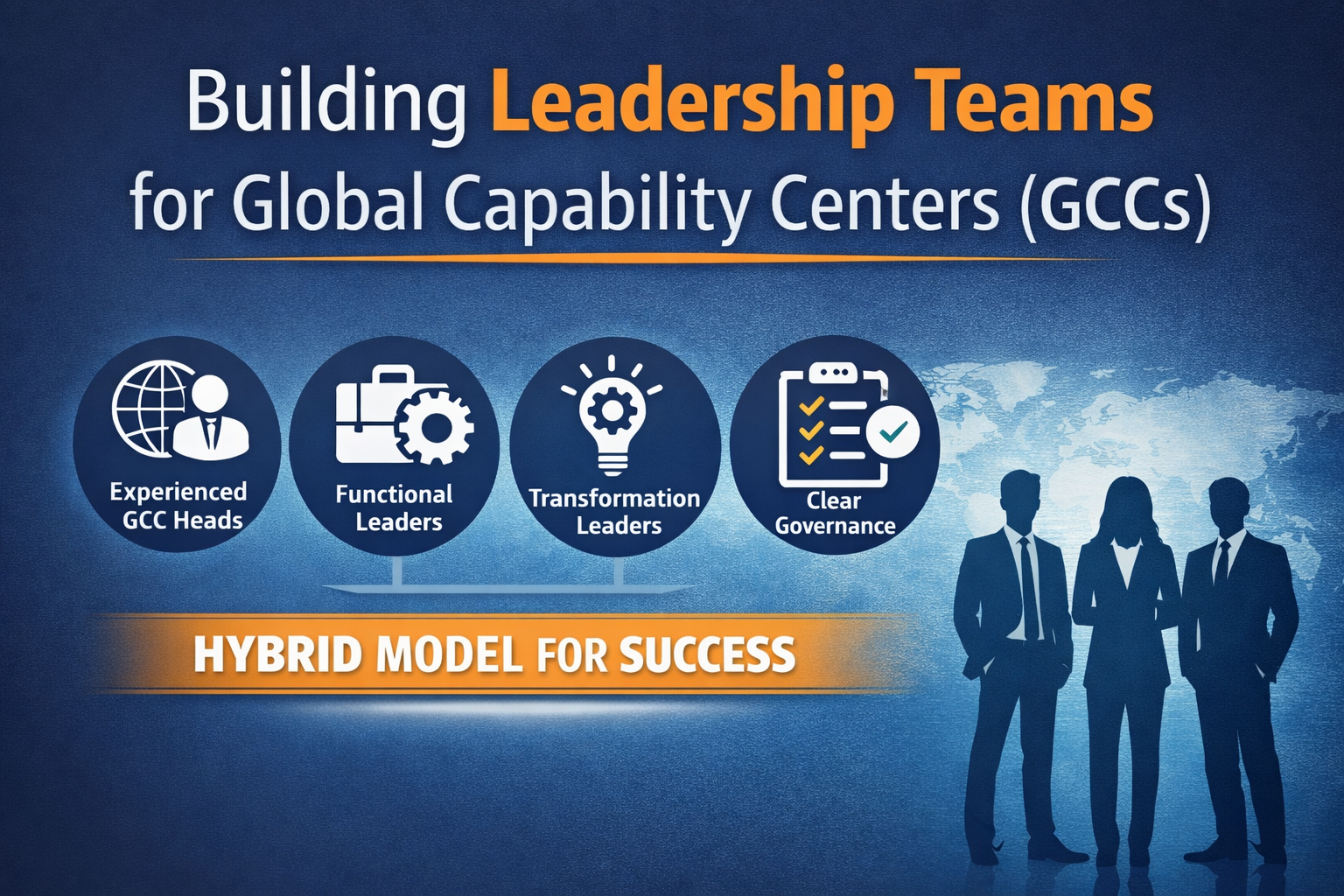
Introduction: Why Leadership Defines GCC Success
Global Capability Centers (GCCs) are no longer just offshore execution hubs—they are strategic engines driving innovation, transformation, and enterprise value. As organizations expand their GCC footprint, one factor consistently determines success or failure: leadership.
Building the right leadership team is not about replicating headquarters—it’s about creating a locally empowered, globally aligned leadership structure that can operate with autonomy while driving enterprise-wide objectives.
The Evolving Role of GCC Leadership
Traditionally, GCC leaders were focused on operational efficiency, cost optimization, and delivery excellence. Today, their role has expanded significantly.
Modern GCC leadership teams are responsible for:
- Driving innovation and digital transformation
- Managing global stakeholder relationships
- Building high-performance talent ecosystems
- Ensuring governance, compliance, and scalability
- Acting as strategic partners to global business units
This shift requires leaders who are not just operators, but visionaries, integrators, and change agents.
Core Leadership Roles in a GCC
A strong GCC leadership team is structured to balance operational excellence with strategic growth. Key roles include:
1. GCC Head / Managing Director
The GCC Head acts as the face of the center and is responsible for:
- Defining strategic direction
- Aligning with global leadership
- Driving growth and capability expansion
- Ensuring governance and performance
This role requires a blend of business acumen, cultural intelligence, and stakeholder management.
2. Functional Leaders (HR, Finance, IT, Operations)
Each function plays a critical role in scaling the GCC:
- HR Leader: Builds talent pipelines, culture, and employer branding
- Finance Leader: Ensures cost control, compliance, and financial planning
- IT Leader: Drives digital transformation and infrastructure
- Operations Leader: Manages delivery excellence and process optimization
These leaders must operate with a global mindset while adapting to local dynamics.
3. Transformation & Innovation Leaders
As GCCs evolve into innovation hubs, organizations are introducing roles focused on:
- Automation and AI adoption
- Process re-engineering
- Digital product development
- Data and analytics strategy
These leaders help shift the GCC from execution to innovation.
4. Client & Stakeholder Engagement Leaders
Strong stakeholder alignment is critical. This role focuses on:
- Managing relationships with global business units
- Driving collaboration across geographies
- Ensuring alignment with enterprise priorities
Without this layer, GCCs risk becoming siloed and underutilized.
Key Traits of High-Impact GCC Leaders
Building a leadership team is not just about roles—it’s about selecting the right capabilities.
1. Global Mindset with Local Execution
Leaders must understand global business priorities while navigating local regulatory, cultural, and talent landscapes.
2. Strategic Thinking Over Tactical Execution
The ability to move beyond day-to-day operations and contribute to enterprise strategy is critical.
3. Change Management Expertise
GCCs often undergo rapid transformation. Leaders must drive change across teams, processes, and technologies.
4. Talent-Centric Leadership
Attracting and retaining top talent in competitive markets like India requires strong people leadership.
5. Collaboration & Influence
GCC leaders must influence stakeholders across geographies without direct authority.
Building vs Hiring: What’s the Right Approach?
Organizations often face a key decision: build leadership internally or hire externally.
Hiring External Leaders
Pros:
- Brings fresh perspectives
- Accelerates setup and scaling
- Adds global experience
Cons:
- Cultural misalignment risks
- Longer onboarding time
Developing Internal Leaders
Pros:
- Strong alignment with company culture
- Faster integration
- Higher retention
Cons:
- May lack GCC-specific experience
- Slower transformation
Best Practice: Hybrid Model
The most successful GCCs adopt a hybrid approach:
- Hire a strong GCC Head with prior experience
- Build and groom functional leaders internally
- Add external experts for transformation roles
Common Mistakes to Avoid
1. Replicating HQ Structure Without Localization
What works in the US or Europe may not work in India. Localization is key.
2. Underinvesting in Leadership
Many organizations focus on hiring junior talent but delay leadership hiring—this creates long-term inefficiencies.
3. Lack of Clear Governance
Ambiguity in roles and responsibilities leads to misalignment and delays.
4. Ignoring Culture Building
Leadership teams must actively shape a distinct GCC culture, not just mirror headquarters.
How to Build a Scalable Leadership Framework
To ensure long-term success, organizations should:
1. Define a Clear Leadership Blueprint
- Roles and responsibilities
- Reporting structures
- Decision-making authority
2. Align Leadership with Business Objectives
Ensure every leader is tied to measurable business outcomes.
3. Invest in Leadership Development
- Training programs
- Global exposure
- Cross-functional collaboration
4. Enable Autonomy with Accountability
Empower leaders to make decisions while maintaining strong governance frameworks.
The Future of GCC Leadership
As GCCs continue to evolve, leadership teams will become:
- More data-driven
- More innovation-focused
- More integrated with global strategy
The next generation of GCC leaders will not just manage operations—they will shape the future of global enterprises.
Conclusion
Building a leadership team for a GCC is a strategic investment, not an operational task. The right leadership structure can transform a GCC from a cost center into a global innovation powerhouse.
Organizations that prioritize leadership early, invest in the right capabilities, and adopt a hybrid approach will be best positioned to unlock the full potential of their GCCs.

Introduction
India’s Global Capability Centre (GCC) ecosystem has entered a new phase of expansion and maturity. In Q1 2026, GCC leasing touched a record-breaking 9.1 million square feet, marking the highest-ever quarterly absorption in the country’s commercial real estate history.
This milestone is not just a real estate statistic—it reflects a deeper structural shift in how global enterprises view India: not as a cost-saving destination, but as a \strategic hub for innovation, technology, and high-value operations.
Record-Breaking Growth in India’s Office Market
India’s overall office leasing reached 20.7 million sq. ft. in Q1 2026, the highest ever for a first quarter, with GCCs contributing 44% of total absorption.
Compared to Q1 2025, the market grew by around 5% year-on-year, demonstrating resilience despite global economic uncertainties.
What This Means:
- GCCs are no longer niche contributors—they are primary demand drivers
- India’s office market fundamentals are strong and stable
- Long-term global investments in India continue to accelerate
Why GCCs Are Driving This Surge
1. India as a Global Operations Hub
Global enterprises increasingly rely on India for:
- Product engineering
- Financial operations (BFSI)
- AI, analytics, and digital transformation
The report highlights that demand spans multiple industries, including e-commerce (24%), BFSI (20%), and technology (20%).
2. Dominance of US-Based Companies
Approximately 73% of GCC leasing demand comes from American firms.
This reinforces India’s position as a trusted global delivery and innovation center for Fortune 500 companies.
3. Rise of Mid-Market and Nano GCCs
Beyond large enterprises, a new trend is emerging:
- Mid-market GCCs handling end-to-end global functions
- Nano GCCs focusing on niche innovation, AI, and R&D
This diversification signals a democratization of the GCC model.
Top Cities Leading GCC Expansion
Bengaluru: The Undisputed Leader
- Accounts for 48% of GCC leasing demand
- Strong talent ecosystem and startup culture
Hyderabad: The Rising Powerhouse
- Holds 19% share
- Known for scalability and cost efficiency
Delhi-NCR: Strategic Growth Hub
- Contributes 14% of GCC demand
Together, these cities dominate India’s GCC landscape, while others like Mumbai, Pune, and Chennai continue to gain traction.
Shift Towards Premium, Sustainable Workspaces
A notable trend in Q1 2026 is the quality preference of GCCs:
- 83% of GCC leasing in green-certified buildings
- 78% in buildings less than 10 years old
Implications:
- GCCs prioritize ESG compliance and sustainability
- Demand is shifting toward Grade A, future-ready infrastructure
- Developers must focus on smart, flexible, and green office spaces
The Bigger Picture: India’s Strategic Advantage
This record leasing activity reinforces several macro trends:
1. Talent Depth at Scale
India continues to offer one of the largest pools of:
- Engineers
- Data scientists
- Finance professionals
2. Cost-to-Value Advantage
While no longer “low-cost,” India delivers high ROI for global capability building.
3. Ecosystem Maturity
India’s GCC ecosystem now supports:
- End-to-end product ownership
- Global innovation mandates
- Advanced R&D and AI development
What This Means for Businesses
For global enterprises considering expansion:
- India is no longer optional—it’s strategic
- Early movers gain talent and cost advantages
- Location strategy (Bengaluru vs Hyderabad vs emerging cities) is critical
For real estate and service providers:
- Demand will shift toward premium and flexible spaces
- Opportunities will grow in Tier-2 cities entering the GCC race
Future Outlook: What’s Next for GCC Growth in India?
The momentum seen in Q1 2026 is expected to continue due to:
- Expansion of digital and AI-driven operations
- Increased adoption of GCC models by mid-sized companies
- Growth of hybrid and flexible workspace strategies
India is on track to become the global headquarters for distributed capability centers, not just a support hub.
Conclusion
The record 9.1 million sq. ft. GCC leasing in Q1 2026 is more than a milestone—it’s a clear signal of India’s transformation into a global innovation powerhouse.
As GCCs evolve from cost centers to strategic hubs, India stands at the center of this transformation—offering scale, talent, and long-term value unmatched by any other market.
Data Source : Link
-
 Tech3 weeks ago
How Revolut Is Turning India Into Its Global GCC Powerhouse
-

 BFSI3 weeks ago
OwnGCC Launches to Help Global Enterprises Build and Scale High-Impact GCCs in Just 90 Days
-

 Business2 weeks ago
How Flutter Entertainment India GCC Is Building Global Talent in a High-Performance Culture
-
 BFSI3 weeks ago
How Deutsche Bank Is Turning Its India GCC into an AI Innovation Engine
-

 Business2 weeks ago
GCC in Coimbatore: Why It’s the Next Big Hub for Global Capability Centers
-
 Politics2 weeks ago
Maximus Expands Hyderabad GCC: Strengthening India’s Role in Global Healthcare & Public Sector Operations
-

 Finance2 weeks ago
InvoiceCloud Expands Hyderabad GCC, Plans to Hire 150 Experts to Drive Fintech Innovation
-

 Bengaluru2 weeks ago
India’s GCC Leasing Boom: Record 9.1 Million Sq. Ft. in Q1 2026 Signals a New Growth Era