
Business
GCC in Coimbatore: Why It’s the Next Big Hub for Global Capability Centers

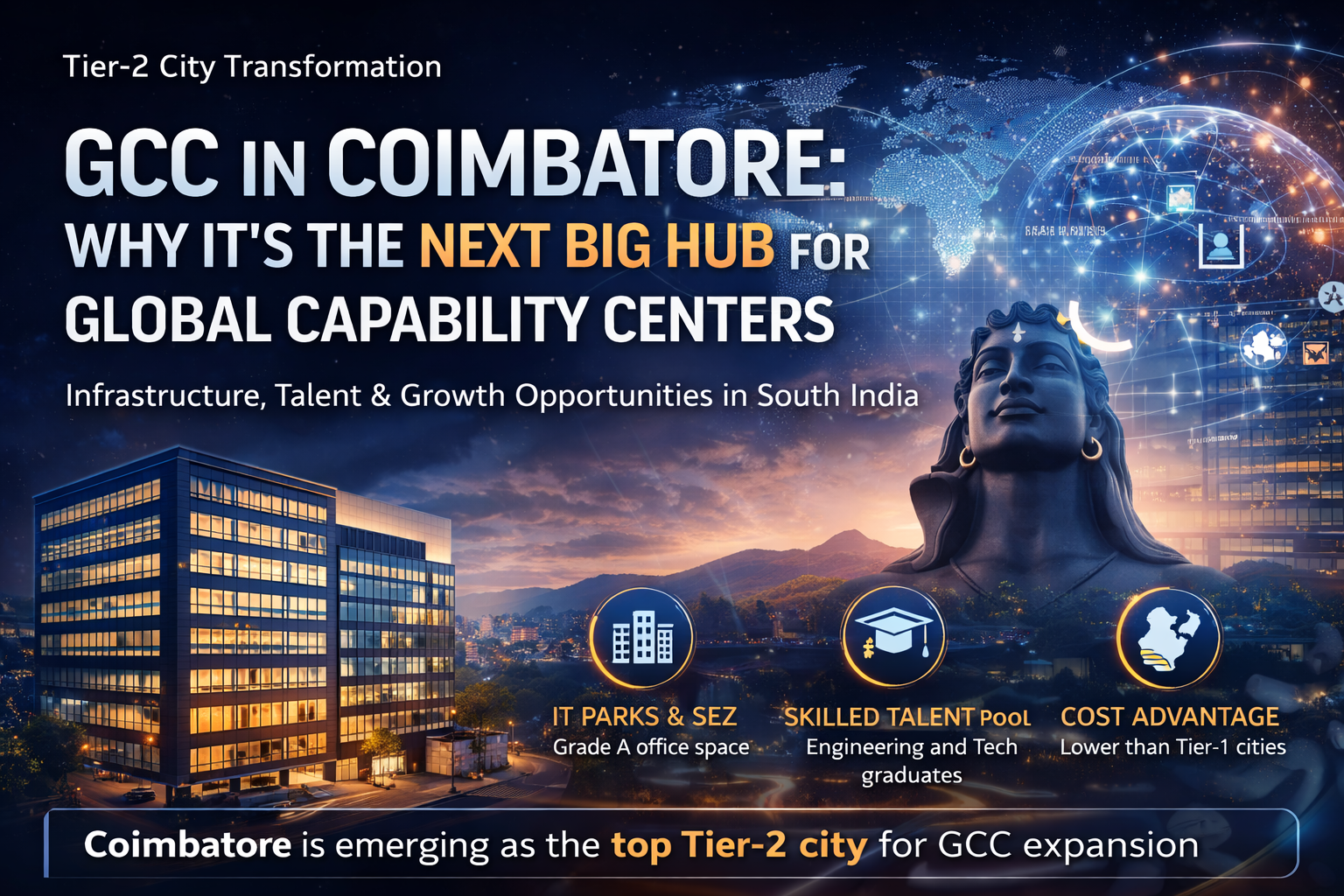
India’s Global Capability Center (GCC) ecosystem is undergoing a structural transformation. While cities like Bengaluru, Hyderabad, and Pune have traditionally dominated the landscape, Tier-2 cities are rapidly emerging as the next frontier. Among them, Coimbatore stands out as a high-potential destination for GCC expansion.
With its strong industrial base, growing IT ecosystem, cost advantages, and talent availability, Coimbatore is uniquely positioned to become a strategic GCC hub for global enterprises.
This article outlines a comprehensive GCC development plan for Coimbatore, covering infrastructure, talent strategy, policy support, and long-term growth opportunities.
Why Coimbatore? The Strategic Advantage
Coimbatore is not just another Tier-2 city—it is a hybrid economic zone combining manufacturing strength with IT and services growth.
Key Advantages:
- Strong engineering and manufacturing ecosystem
- Growing IT and software services presence
- Lower operational and real estate costs (30–50% lower than Tier-1 cities)
- Access to skilled graduates from top institutions
- Improved connectivity and infrastructure
This combination creates a cost-to-capability advantage, making Coimbatore highly attractive for GCCs.
The Rising Role of Tier-2 Cities in GCC Expansion
The GCC model is evolving beyond cost arbitrage.
Key Trends Driving Expansion:
- Talent saturation in Tier-1 cities
- Rising employee costs and attrition
- Demand for distributed global delivery models
- Government push for regional economic development
Coimbatore fits perfectly into this shift, offering scalability without the constraints of metro cities.
Infrastructure Development Plan
A successful GCC ecosystem depends heavily on infrastructure readiness.
1. IT Parks & SEZ Expansion
- Expansion of ELCOT IT parks
- Development of new Grade A office spaces
- Plug-and-play infrastructure for faster GCC setup
2. Connectivity Enhancements
- Upgrading Coimbatore International Airport
- Improved road connectivity (NH corridors)
- Better intra-city transport systems
3. Smart City Integration
- Digital infrastructure (5G readiness)
- Smart utilities and urban planning
- Sustainable energy adoption
Talent Development Strategy
Talent is the backbone of any GCC.
1. Academic-Industry Collaboration
- Partnerships with engineering colleges
- Curriculum aligned with GCC requirements
- Internship and apprenticeship programs
2. Skill Development Programs
- Focus on AI, data analytics, cloud, and cybersecurity
- Government-supported skilling initiatives
- Certification-driven learning pathways
3. Talent Retention Strategy
- Competitive salaries with lower cost of living
- Better work-life balance compared to metros
- Strong local hiring ecosystem
Technology & Innovation Focus
Modern GCCs are innovation hubs—not just delivery centers.
Key Focus Areas:
- Artificial Intelligence & Machine Learning
- Robotic Process Automation (RPA)
- Fintech and SaaS product development
- IoT and Industry 4.0 (leveraging Coimbatore’s manufacturing base)
Innovation Enablement:
- Setting up innovation labs and incubators
- Encouraging startup-GCC collaboration
- Promoting R&D investments
Government & Policy Support
Government backing is critical for GCC growth.
Key Initiatives:
- Tax incentives for IT and GCC companies
- Simplified regulatory frameworks
- Single-window clearance systems
- Infrastructure subsidies
Tamil Nadu government’s focus on decentralized IT growth positions Coimbatore as a priority city.
Industry Opportunities for GCCs in Coimbatore
Coimbatore’s strengths align well with multiple industries:
1. Manufacturing & Engineering GCCs
- Supply chain optimization
- Product engineering
- Industrial automation
2. BFSI & Fintech GCCs
- Risk analytics
- Payment systems
- Compliance operations
3. Healthcare & MedTech
- Health data analytics
- Telemedicine platforms
- Medical device R&D
4. SaaS & IT Services
- Product development
- Customer success operations
- Global support centers
Economic Impact of GCC Growth
A well-executed GCC strategy can transform Coimbatore’s economy.
Expected Outcomes:
- Job creation (10,000+ high-value roles in 5–7 years)
- Increase in real estate demand
- Growth of ancillary industries
- Rise in startup ecosystem
GCC Setup Roadmap for Companies
For enterprises planning a GCC in Coimbatore:
Phase 1: Market Entry
- Feasibility study
- Location selection
- Talent mapping
Phase 2: Setup
- Office infrastructure
- Hiring core leadership
- Initial team onboarding
Phase 3: Scale
- Expand functions
- Build innovation capabilities
- Integrate with global operations
Challenges & Mitigation Strategies
Challenges:
- Limited global exposure compared to Tier-1 cities
- Initial talent readiness gaps
- Perception as a non-metro location
Solutions:
- Strong employer branding
- Training and upskilling programs
- Strategic partnerships with universities
Future Outlook
Coimbatore is on track to become a top Tier-2 GCC destination in India.
With the right investments in:
- Infrastructure
- Talent
- Policy
The city can evolve into a global hub for innovation, technology, and operations.
Final Take
The GCC opportunity in Coimbatore is not just about expansion—it’s about strategic transformation.
Companies that invest early will gain:
- Cost advantages
- Talent access
- Long-term scalability
The next wave of GCC growth will not be limited to metros.
It will be built in cities like Coimbatore.
Business
Shiney Prasad Joins Aon to Lead Global Capability Centers: A Strategic Move in the Evolving GCC Landscape

In a significant leadership development within the Global Capability Center (GCC) ecosystem, Shiney Prasad has taken on the role of Head of Global Capability Centers at Aon. This appointment reflects a broader shift in how enterprises are reimagining GCCs—not as support units, but as strategic engines of innovation and value creation.
A Leadership Move Aligned with GCC Evolution
Aon’s decision to bring in Shiney Prasad comes at a time when GCCs are rapidly transitioning from cost-efficiency hubs to high-impact global delivery centers. His role is expected to strengthen Aon’s ability to integrate global talent, analytics, and domain expertise into a cohesive operating model.
The company’s GCCs already play a critical role in enabling business outcomes by connecting capabilities across geographies. With Shiney at the helm, the focus will likely intensify on scaling innovation and delivering more integrated, client-centric solutions.
Driving Innovation Through Integrated Capabilities
Aon has been actively aligning its operations under a unified strategy, where GCCs are positioned as key enablers of transformation. Shiney Prasad’s leadership is expected to accelerate this vision by:
- Enhancing cross-functional collaboration across global teams
- Leveraging data and analytics for smarter decision-making
- Strengthening operational transformation initiatives
- Building scalable, future-ready delivery models
This approach aligns with the broader trend where GCCs are no longer judged by operational efficiency alone, but by their contribution to enterprise-wide innovation and strategic outcomes.
A Leader with Deep Industry and Transformation Expertise
Shiney Prasad brings decades of experience across insurance, consulting, and global operations. His career spans leadership roles in organizations such as Guardian Life, Sun Life, EY, and other multinational firms, where he has led large-scale transformation, digital initiatives, and GCC operations.
His expertise in areas like operational transformation, digital strategy, and enterprise scaling makes him well-positioned to lead Aon’s GCC strategy in a highly competitive and evolving landscape.
What This Means for the GCC Ecosystem
This appointment signals a larger industry shift:
- GCC leadership roles are becoming more strategic and transformation-focused
- Companies are investing in leaders with cross-domain expertise
- Innovation, AI, and analytics are becoming core to GCC mandates
- India continues to strengthen its position as a global GCC hub
Aon’s move reinforces the idea that the future of GCCs lies in their ability to drive business impact—not just support it.
The Road Ahead
As GCCs continue to evolve into innovation hubs, leadership will play a defining role in shaping their trajectory. Shiney Prasad’s appointment is a clear indicator that organizations are prioritizing strategic leadership to unlock the full potential of their global capability networks.
For Aon, this marks the beginning of a new chapter—one where GCCs are not just operational backbones but critical drivers of growth, innovation, and competitive advantage.

When we start a business, most of us try to keep the accounting and bookkeeping tasks to ourselves. It feels practical — we’re trying to save money, stay lean, and manage everything on our own.
But as the business grows, those “DIY” habits start to show cracks – mostly due to lack of time and changing priorities. The result? You start getting behind your books by days, weeks and sometimes months. Transactions pile up, invoice entries get missed, reconciliations get delayed, and suddenly the numbers stop showing the true picture of your business.
What once felt manageable becomes messy, stressful, and risky. That’s when you need a professional bookkeeper to manage your books and accounts.
The Role a Bookkeeper Plays in Your Business
Professional bookkeepers are certified professionals who use their skills, knowledge, and expertise to keep your financial data complete, accurate, and up to date. They work on your books, on your behalf, and bring structure, accuracy, and clarity to your financial data—giving you a reliable foundation to run your business.
Their role goes beyond just data entry. A good bookkeeper helps you:
- Record and categorize daily transactions
- Reconcile bank and credit card statements
- Manage accounts payable and receivable
- Maintain clean and audit-ready books
- Generate financial reports
More importantly, they ensure your numbers actually reflect the reality of your business, so you can make informed decisions.
When Do You Need a Bookkeeper?
Most businesses don’t need a bookkeeper from day one, but as your business grows, professional support becomes essential. Here are some signs it’s time to hire a bookkeeping specialist:
- You’re always behind on your books, either due to lack of time or knowledge of
- You don’t know your exact cash flow position
- Your personal and business finances are all mixed up
- You’re spending too much time on bookkeeping instead of growing your business
- Your financial reports don’t make sense
- Tax season feels stressful
If any of these sound familiar, your business has likely outgrown DIY bookkeeping.
Benefits of Hiring a Professional Bookkeeper
Bookkeepers are not just “number crunchers”. They are financial wizards that help strengthen your business foundation by providing real-time visibility into your financial data.
- They Keep Your Numbers Clean
Professional bookkeepers ensure that all your transactions are recorded properly and on time, so your reports reflect the reality of your business.
- They Save You from Costly Mistakes
Duplicate payments, missed invoices, and misclassified expenses can all lead to financial losses, inaccurate reporting, and compliance issues. A professional bookkeeper diligently works on your books and keeps your records accurate, helping you avoid costly errors and hefty fines and penalties.
- They Make Month-End Closing Quick and Smooth
With clean books and reconciled accounts, you can quickly lock your numbers and close your books every month — no more last-minute stress or month-/ year-end chaos.
- They Help You File Your Taxes on Time
Filing taxes becomes stressful when your books are incomplete or disorganized. A professional bookkeeper keeps your financial data accurate and updated all through the year so that when tax season arrives, everything is already in place. This makes tax filing smooth and hassle-free.
- They Help in Accurate Budgeting and Forecasting
Budgeting and forecasting rely heavily on accurate financial data. If your books are not up to date, your projections can never be accurate. A professional bookkeeper keeps your financial records clean and organized, so you can create realistic budgets with confidence.
- They Free Up Your Time
Maintaining your books and keeping financial records up to date can be time-consuming and repetitive. By leveraging outsourced bookkeeping services, you can free up your valuable time and internal resources.
Instead of getting caught up in spreadsheets and daily entries, you can focus on growing your business, improving operations, and making strategic decisions.
- They Help Build Credibility with Stakeholders
Accurate and well-maintained financial records are extremely important for building trust and credibility among stakeholders. Bookkeepers keep your accounts organized and ready to be shared when needed. Professional support makes it easier to secure funding, partnerships, and growth opportunities.
How Much Does an Outsourced Bookkeeper Cost?
Many business owners hesitate because they see bookkeeping as an added expense.
But the real question is—what is it costing you to not have one?
The cost of hiring an in-house bookkeeper comes with more than just salary. It includes additional expenses like employee benefits, software subscriptions, training, and infrastructure. This quickly increases your overall monthly spend. Not to forget the cost of retaining resources even during off season.
On the other hand, outsourced bookkeeping offers a more flexible and cost-effective alternative. You pay only for the services you need, when you need, while accessing experienced professionals and better tools. It helps you save 30-60% on your bookkeeping expenses.
That’s why before making a move, it is important to know the complete cost breakdown of in-house versus outsourced bookkeeping and find the right approach for your business.
Pro Tip: Many businesses today go a step further by building their own Global Capability Centers (GCCs) via BOT (Build-Operate-Transfer model) to manage their bookkeeping and accounting functions more efficiently without building an in-house team.
Unlike in-house hiring or traditional outsourcing, GCC allows you to build a dedicated team that works exclusively for your business. You benefit from global talent, standardized processes, and better operational flexibility without the initial complexity and cost of setting up an offshore team all by yourself.
For businesses looking to grow without building a large in-house team, GCCs BOT expansion model offers the perfect balance between control, cost savings, and expertise.
Profitable Business Decisions Start with Clean Books and Reliable Numbers
Here’s the bottom line: you can’t make profitable decisions without accurate data.
- If you don’t know your true costs, you can’t price correctly.
- If you don’t know your cash flow, you can’t plan for growth.
- If you don’t know your margins, you can’t decide which products or services to focus on.
Bookkeepers give you the clarity you need to make smarter, more profitable decisions. So, hire a professional bookkeeper. It will not only save your time but will also protect your business from errors, giving you reliable data and absolute peace of mind.
Remember: Profitable decisions start with clean, accurate books, which in turn depends on good bookkeeping. So, if you are behind your books, it’s time to seek professional support. Partner with a professional bookkeeping service provider and start making profitable business decisions, confidently!

Introduction
India’s Global Capability Centre (GCC) ecosystem has entered a new phase of expansion and maturity. In Q1 2026, GCC leasing touched a record-breaking 9.1 million square feet, marking the highest-ever quarterly absorption in the country’s commercial real estate history.
This milestone is not just a real estate statistic—it reflects a deeper structural shift in how global enterprises view India: not as a cost-saving destination, but as a \strategic hub for innovation, technology, and high-value operations.
Record-Breaking Growth in India’s Office Market
India’s overall office leasing reached 20.7 million sq. ft. in Q1 2026, the highest ever for a first quarter, with GCCs contributing 44% of total absorption.
Compared to Q1 2025, the market grew by around 5% year-on-year, demonstrating resilience despite global economic uncertainties.
What This Means:
- GCCs are no longer niche contributors—they are primary demand drivers
- India’s office market fundamentals are strong and stable
- Long-term global investments in India continue to accelerate
Why GCCs Are Driving This Surge
1. India as a Global Operations Hub
Global enterprises increasingly rely on India for:
- Product engineering
- Financial operations (BFSI)
- AI, analytics, and digital transformation
The report highlights that demand spans multiple industries, including e-commerce (24%), BFSI (20%), and technology (20%).
2. Dominance of US-Based Companies
Approximately 73% of GCC leasing demand comes from American firms.
This reinforces India’s position as a trusted global delivery and innovation center for Fortune 500 companies.
3. Rise of Mid-Market and Nano GCCs
Beyond large enterprises, a new trend is emerging:
- Mid-market GCCs handling end-to-end global functions
- Nano GCCs focusing on niche innovation, AI, and R&D
This diversification signals a democratization of the GCC model.
Top Cities Leading GCC Expansion
Bengaluru: The Undisputed Leader
- Accounts for 48% of GCC leasing demand
- Strong talent ecosystem and startup culture
Hyderabad: The Rising Powerhouse
- Holds 19% share
- Known for scalability and cost efficiency
Delhi-NCR: Strategic Growth Hub
- Contributes 14% of GCC demand
Together, these cities dominate India’s GCC landscape, while others like Mumbai, Pune, and Chennai continue to gain traction.
Shift Towards Premium, Sustainable Workspaces
A notable trend in Q1 2026 is the quality preference of GCCs:
- 83% of GCC leasing in green-certified buildings
- 78% in buildings less than 10 years old
Implications:
- GCCs prioritize ESG compliance and sustainability
- Demand is shifting toward Grade A, future-ready infrastructure
- Developers must focus on smart, flexible, and green office spaces
The Bigger Picture: India’s Strategic Advantage
This record leasing activity reinforces several macro trends:
1. Talent Depth at Scale
India continues to offer one of the largest pools of:
- Engineers
- Data scientists
- Finance professionals
2. Cost-to-Value Advantage
While no longer “low-cost,” India delivers high ROI for global capability building.
3. Ecosystem Maturity
India’s GCC ecosystem now supports:
- End-to-end product ownership
- Global innovation mandates
- Advanced R&D and AI development
What This Means for Businesses
For global enterprises considering expansion:
- India is no longer optional—it’s strategic
- Early movers gain talent and cost advantages
- Location strategy (Bengaluru vs Hyderabad vs emerging cities) is critical
For real estate and service providers:
- Demand will shift toward premium and flexible spaces
- Opportunities will grow in Tier-2 cities entering the GCC race
Future Outlook: What’s Next for GCC Growth in India?
The momentum seen in Q1 2026 is expected to continue due to:
- Expansion of digital and AI-driven operations
- Increased adoption of GCC models by mid-sized companies
- Growth of hybrid and flexible workspace strategies
India is on track to become the global headquarters for distributed capability centers, not just a support hub.
Conclusion
The record 9.1 million sq. ft. GCC leasing in Q1 2026 is more than a milestone—it’s a clear signal of India’s transformation into a global innovation powerhouse.
As GCCs evolve from cost centers to strategic hubs, India stands at the center of this transformation—offering scale, talent, and long-term value unmatched by any other market.
Data Source : Link
-
 Tech3 weeks ago
How Revolut Is Turning India Into Its Global GCC Powerhouse
-

 BFSI3 weeks ago
OwnGCC Launches to Help Global Enterprises Build and Scale High-Impact GCCs in Just 90 Days
-
 BFSI3 weeks ago
How Deutsche Bank Is Turning Its India GCC into an AI Innovation Engine
-

 Business2 weeks ago
How Flutter Entertainment India GCC Is Building Global Talent in a High-Performance Culture
-

 Finance2 weeks ago
InvoiceCloud Expands Hyderabad GCC, Plans to Hire 150 Experts to Drive Fintech Innovation
-
 Politics2 weeks ago
Maximus Expands Hyderabad GCC: Strengthening India’s Role in Global Healthcare & Public Sector Operations
-

 Bengaluru2 weeks ago
India’s GCC Leasing Boom: Record 9.1 Million Sq. Ft. in Q1 2026 Signals a New Growth Era
-

 Bengaluru2 weeks ago
Fidelity’s Bengaluru Expansion Signals the Next Phase of GCC Evolution in India