
Podcast
The BPO Industry Has 5 Years Left?

AI Won’t Replace Outsourcing Teams. It Will Redefine How They Deliver: Vinesh Nair on the Future of Global Operations
From call centre sales executive to entrepreneur, Vinesh Nair shares how AI, human expertise, cultural alignment, and operational innovation are changing the outsourcing industry.
The outsourcing industry is entering a new phase of transformation. For decades, businesses have relied on offshore teams to reduce operational costs, expand capacity, and improve service delivery. However, artificial intelligence is changing the economics of traditional outsourcing, forcing service providers to rethink how they operate, compete, and deliver value.
In an episode of CXO Room, Vinesh Nair, CSO and Co-founder of Mission Six Solution, joined host Mani to discuss his 15-year professional journey, the challenges of building an outsourcing business, and why he believes the future belongs to organisations that combine human expertise with AI-driven automation.
His perspective is particularly relevant as global businesses increasingly evaluate outsourcing partners based on operational efficiency, quality, technology adoption, and measurable business outcomes rather than manpower availability alone.
From Call Centre Sales Executive to Business Leader
Vinesh’s professional journey began in 2011 as a call centre sales executive in Mumbai, where he handled US customers and sold products and services on behalf of clients.
What started as an entry-level sales position gradually developed into a career spanning sales, business development, operations, and leadership.
During his early career, he worked with organisations including eBay and McDonald’s before moving into the US outsourcing industry. He spent approximately nine years with an outsourcing organisation in Bengaluru, gaining exposure to client management, service delivery, team leadership, and international business development.
This experience gave him a deeper understanding of how outsourcing businesses function behind the scenes.
Working closely with international customers also helped him recognise an important distinction: winning a client is only the beginning. Consistently delivering the results promised during the sales process is what builds long-term business relationships.
Eventually, this experience inspired him to move beyond selling outsourcing services and establish his own business.
The Biggest Career Challenge: Moving from Employee to Employer
One of the most significant moments in Vinesh’s journey was transitioning from an employee to an entrepreneur.
After spending 15 years in the corporate environment, taking the risk of building a business was not an easy decision.
He explained that the biggest challenge was moving from a position where he was responsible for delivering services to clients to becoming the person accountable for building the entire service delivery operation.
The transition required a different mindset, greater responsibility, and the confidence to make independent business decisions.
Support from his family, friends, business partners, and former colleagues played an important role in making the decision possible.
For Vinesh, entrepreneurship also created an opportunity to introduce operational changes that he believed could make a meaningful difference to clients.
Rather than building another conventional outsourcing company, he wanted to create a business that would integrate technology and automation into its service delivery model.
Moving Beyond Traditional Outsourcing with AI
One of the central themes of the conversation was the growing influence of artificial intelligence on outsourcing and call centre operations.
Vinesh explained that his interest in AI developed during his previous corporate experience, when questions about the future of the industry and the impact of automation began to emerge.
Instead of viewing AI as a threat, he spent approximately six months exploring automation opportunities and evaluating how these technologies could improve operational delivery.
This research led him to an important business question:
Could an outsourcing company deliver significantly better results by combining experienced professionals, automation, and AI rather than simply providing manpower?
His answer was to build a service model around that combination.
According to Vinesh, the objective is not simply to win outsourcing projects and execute conventional operations. The focus is on continuously identifying opportunities to automate activities, improve processes, and deliver better results using the same or fewer resources.
This represents a shift from manpower-driven outsourcing towards technology-enabled service delivery.
Can AI and Human Teams Deliver Better Results Together?
Vinesh strongly believes that AI should complement human capabilities rather than replace them entirely.
During the discussion, he referred to research figures suggesting that AI alone could resolve approximately 74% of support tickets, while combining AI with human intervention could increase the resolution rate to around 87%.
The figures were discussed during the podcast and illustrate his central argument: technology can handle repetitive activities, but human judgement and intervention remain important for achieving better outcomes.
For outsourcing businesses, this creates opportunities to redesign operational workflows.
AI can support activities such as:
- Handling repetitive customer enquiries.
- Automating routine back-office processes.
- Supporting agents with real-time information.
- Reducing manual workloads.
- Improving operational consistency.
- Helping teams focus on more complex customer requirements.
However, human professionals remain important for decision-making, exception handling, customer relationships, quality control, and situations requiring contextual understanding.
Vinesh sees this human-plus-AI approach as the future of the industry over the next five years.
His position is clear: organisations that resist AI adoption risk losing competitiveness, while those that implement it responsibly can improve productivity and service quality.
30–40% Operational Cost Savings Without Compromising Quality
Cost optimisation remains one of the primary reasons businesses consider outsourcing.
However, Vinesh believes that meaningful savings should come from improving the overall operating model rather than simply reducing employee costs.
During the podcast, he discussed a potential 30–40% reduction in operational costs for clients working with his organisation.
He explained that this estimate comes from evaluating the cost structures of more than 100 customers and comparing their existing operational expenses with the proposed service delivery model.
The savings, according to him, can come from several areas:
- Process optimisation: Identifying operational gaps and eliminating unnecessary activities.
- Automation: Introducing AI and automation tools to reduce repetitive manual work.
- Resource utilisation: Achieving better productivity with existing team capacity.
- Technology integration: Using technology to improve delivery efficiency at a lower operational cost.
He also clarified that savings vary depending on each client’s business model, existing cost structure, and operational requirements.
Importantly, the approach is not based on replacing entire teams with AI. Instead, it focuses on combining technology and human resources to achieve better operational economics.
For global businesses evaluating outsourcing partnerships, this is an increasingly important distinction.
Why Cultural Understanding Matters in US Outsourcing Operations
Offshore outsourcing involves more than providing skilled employees at competitive costs.
One of the challenges Vinesh highlighted was preparing Indian professionals to communicate effectively with US customers.
He pointed out that speaking English fluently does not automatically translate into understanding American business culture, customer expectations, communication styles, and professional etiquette.
This is particularly important in customer-facing operations, where communication quality directly influences customer experience.
To address this challenge, the company uses an ongoing training approach involving experienced US-based trainers and consultants.
Vinesh specifically highlighted the contributions of Larry Wilcox, a senior consultant with more than three decades of industry experience, and Sophia, a trainer based in the US office.
The training covers several areas:
- American communication styles and cultural understanding.
- Customer interaction and professional etiquette.
- Appropriate communication practices.
- Understanding customer expectations.
- Maintaining professional standards during customer conversations.
Rather than treating training as a one-time activity before a campaign begins, the organisation conducts regular sessions, including daily, weekly, and bi-weekly training activities.
Vinesh also emphasised that these sessions involve everyone, including leadership.
The broader message is that successful outsourcing depends on cultural alignment and customer understanding, not simply language proficiency.
Remote Staffing Is Not the Problem. Leadership and Process Are.
Another important discussion point was remote staffing and the challenges global businesses face when managing offshore teams.
According to Vinesh, remote staffing is not a new operating model. It has existed for years, and the real challenge is improving how these distributed teams are managed.
He believes that strong leadership, structured processes, and clear accountability are more important than the physical location of the workforce.
An additional concern among international clients is losing operational control when they outsource activities to an external service provider.
Vinesh explained that the first 90 days of an engagement are particularly important for establishing confidence and demonstrating delivery capabilities.
His approach divides the initial period into two stages:
First 30 days – Learning and understanding
The team focuses on understanding the client’s processes, analysing business objectives, identifying operational requirements, and determining how the expected results will be delivered.
Days 60–90 – Performance and accountability
The focus shifts towards achieving weekly targets, implementing processes, monitoring performance, and demonstrating measurable progress.
He also acknowledged that not every client or business will fit into the same delivery framework. Operational experience and the ability to adapt to individual business requirements remain important.
This approach highlights a key requirement for modern outsourcing partnerships: clients need visibility, accountability, and confidence in execution.
The Future of Outsourcing: From Manpower Supply to Intelligent Operations
Perhaps the most interesting part of the conversation was Vinesh’s outlook on the future of the outsourcing industry.
Traditional outsourcing companies have often competed based on workforce size, pricing, and the ability to scale teams quickly.
However, AI is changing this competitive landscape.
Businesses can increasingly automate activities that previously required large teams. This means outsourcing providers will need to demonstrate value beyond simply supplying employees.
Vinesh believes the next generation of outsourcing companies must be prepared to integrate AI into their operations rather than resist technological change.
He also cautioned against expecting AI to independently manage every business process.
Even as AI agents become more capable, human supervision will remain important to ensure that systems follow the right processes, make appropriate decisions, and deliver the intended outcomes.
His perspective is that the future will be shaped by organisations that know where to deploy AI, where human expertise is essential, and how to make both work together.
He is particularly excited about the pace of innovation and believes businesses should focus on the developments happening now rather than waiting until 2030 to prepare for change.
What This Means for the Global Outsourcing and GCC Ecosystem
Vinesh’s perspective reflects a broader shift taking place across the global outsourcing and Global Capability Center (GCC) ecosystem.
Multinational companies are increasingly looking beyond traditional offshore staffing models. They want operating partners and delivery centres that can contribute to automation, technology adoption, productivity improvements, and business transformation.
Several important trends emerge from the conversation:
1. Technology will redefine outsourcing economics
AI and automation are changing how service providers calculate operational costs, allocate resources, and measure productivity.
2. Human expertise will remain a competitive advantage
Customer relationships, cultural understanding, judgement, and exception management continue to require human capabilities.
3. Training must evolve beyond technical skills
Global delivery teams need to understand international customer expectations, communication practices, and business culture.
4. Clients will demand greater operational transparency
Outsourcing partners must establish trust through structured onboarding, measurable performance, and consistent delivery.
5. Service providers must move beyond manpower-based models
The ability to combine people, processes, and technology will increasingly differentiate successful outsourcing businesses.
For GCCs, these developments are equally relevant. As organisations expand their India operations, the focus is shifting towards building intelligent operating environments that combine global talent with AI-enabled workflows.
The Road Ahead
The outsourcing industry is not disappearing. It is evolving.
The traditional model of providing large teams to manage repetitive activities is gradually giving way to a more intelligent approach built around automation, specialised talent, operational efficiency, and measurable business outcomes.
Vinesh Nair’s journey from a call centre sales executive to an entrepreneur reflects this transformation. His experience also highlights why understanding the operational side of outsourcing is just as important as understanding sales and client acquisition.
His message to the industry is straightforward: AI should not be viewed only as a technology that reduces manpower. It should be seen as an opportunity to improve how businesses operate.
The companies that embrace this change, invest in people, and integrate AI responsibly will be better positioned to compete in the next generation of global service delivery.
The future of outsourcing will not be about how many people a company can deploy. It will be about how intelligently those people and technologies work together.
About the CXO Room Conversation
This discussion features Vinesh Nair, CSO and Co-founder of Mission Six Solution, in conversation with Mani on CXO Room.
The episode explores entrepreneurship, US outsourcing operations, AI adoption, operational cost optimisation, workforce training, and the future of global service delivery.
Watch the full conversation: https://youtu.be/xdBUZ3iJP3Q
About GCC Lens
GCC Lens explores the evolving Global Capability Center ecosystem, covering GCC expansions, leadership movements, workplace transformation, technology adoption, and the future of global business operations.
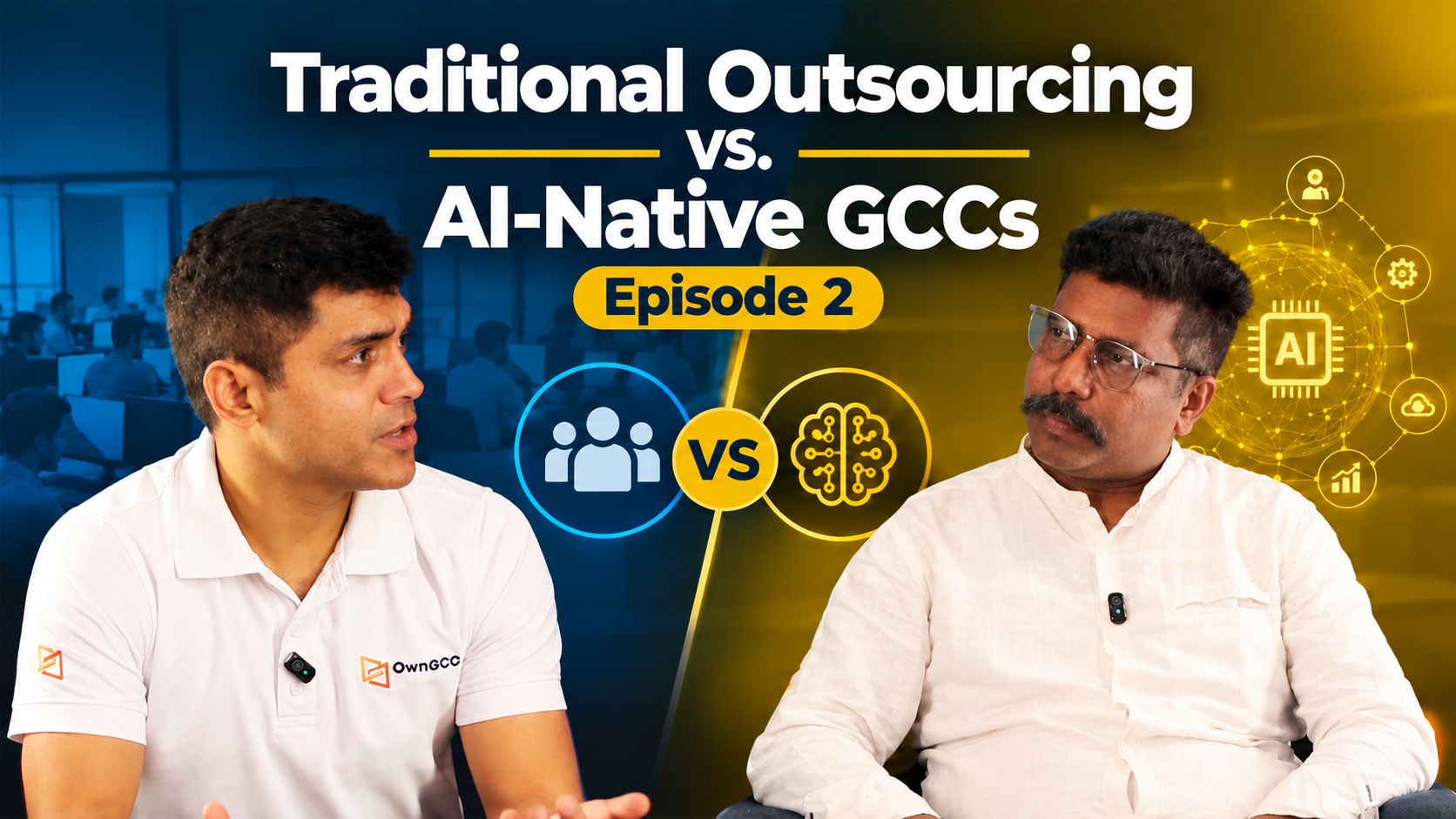
AI is changing the way companies work — and traditional outsourcing may never look the same again.
In Episode 2, we go deeper into the future of AI, Global Capability Centers (GCCs), outsourcing, automation, and the changing nature of work.
Rajeev shares his perspective on how AI is already being integrated into OwnGCC, from mortgage knowledge systems and HR platforms to insurance CRM and operational dashboards.
We also discuss some of the biggest questions facing businesses today:
🔹 How will AI transform the mortgage industry?
🔹 Who is responsible when an AI system makes a mistake?
🔹 How much control should companies give intelligent AI systems?
🔹 Can a GCC be launched and operational within 90 days?
🔹 Why do some GCCs fail or downsize within 2–3 years?
🔹 How does the Build-Operate-Transfer (BOT) model work?
🔹 Why traditional outsourcing could decline as companies build their own GCCs?
🔹 What role will AI automation play in future GCC operations?
🔹 Why GCC leaders need to become strategic business partners—not just executors?
One of the biggest takeaways from the conversation:
The future isn’t about simply adding more people. It’s about combining global talent, technology, AI, and business capability to create measurable value.
The conversation also explores why companies may increasingly move from renting outsourced services to building capabilities they own, as the nature of work continues to change.
⏱️ Topics Covered
00:00 Building the right Advisory Board
02:29 How OwnGCC is approaching AI
05:09 AI’s impact on the mortgage industry
07:38 Who takes responsibility when AI makes a mistake?
09:57 Where can AI still fall short?
12:29 Building a GCC in 90 days
14:05 Why some GCCs fail
16:03 Understanding the Build-Operate-Transfer model
17:49 The future of GCCs in India
19:04 The biggest GCC myths and challenges
21:00 The future of GCC leadership
Watch Episode 2 and join the conversation about where outsourcing, AI and GCCs are heading next.
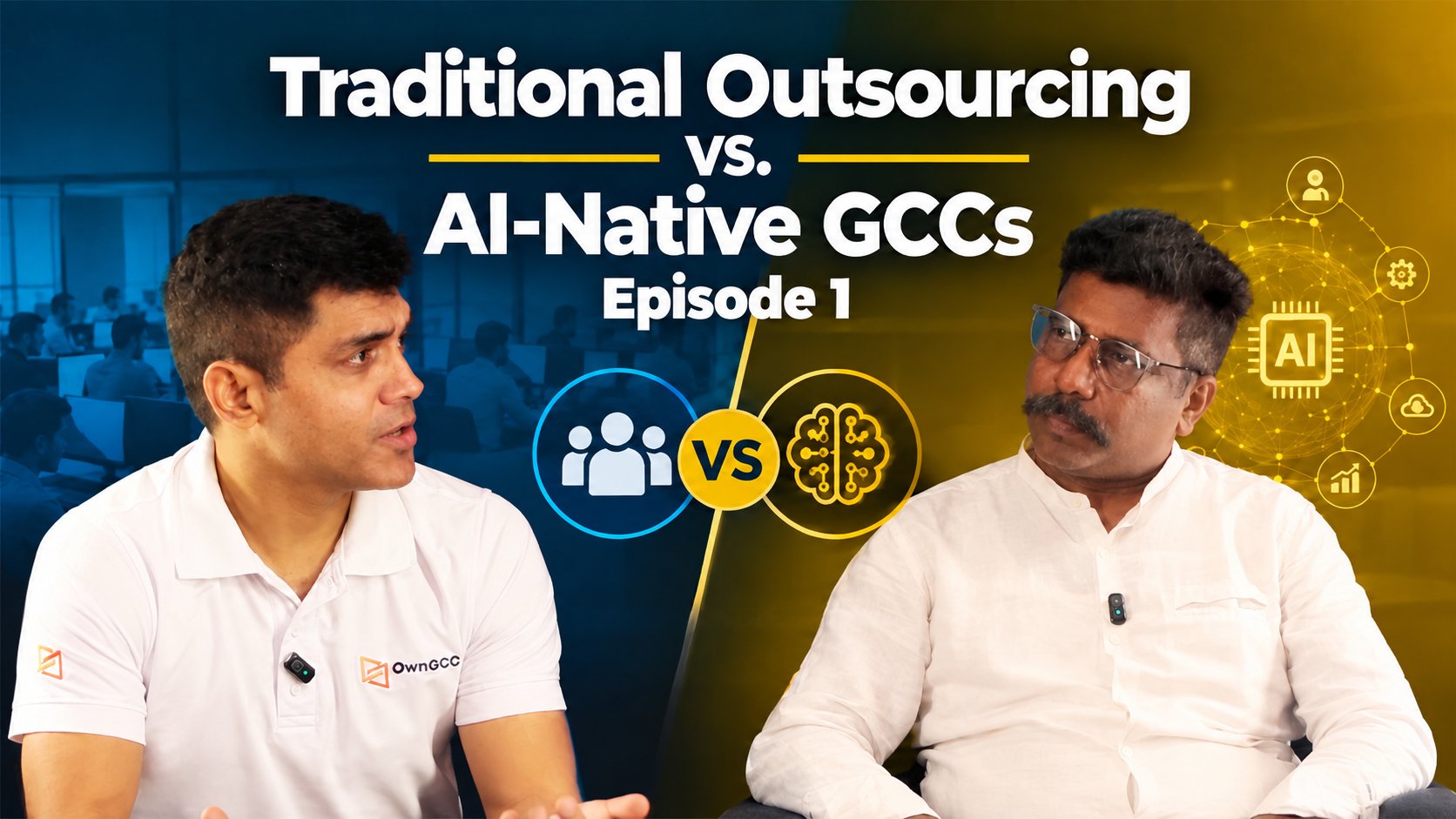
What happens when a two-decade outsourcing veteran decides that the traditional outsourcing model is no longer enough? In this episode of CXO Room, Mani speaks with Rajeev Kumar, Co-founder & CEO of OwnGCC, about why he moved from traditional outsourcing to building a new GCC model focused on precision, specialized talent, AI, and business impact. Rajeev shares his journey, the changes he saw coming with Gen AI, and why he believes the future of outsourcing will require fewer people with deeper expertise. In this episode: Why Rajeev decided to start OwnGCC from scratch What AI is changing in the traditional outsourcing model Scale vs. precision: how GCCs approach work differently Why specialized talent matters more than simply adding headcount How AI is changing mortgage operations The impact of changing mortgage volumes and interest rates Why companies are becoming more open to experimentation AI, automation, exception handling and specialized underwriting What traditional outsourcing may struggle to deliver in an AI-driven environment “Traditional outsourcing was built for scale. OwnGCC is built for precision.” Watch the full conversation to understand how the GCC model is evolving from repetitive execution toward specialized expertise, decision-making, AI and measurable business impact. 🎙️ Welcome to CXO Room — Real conversations. Real business. No scripted success stories.
-

 Business7 months ago
S&P Global Expands India Footprint with New Gurugram Hub
-
 New GCC5 months ago
Generac Launches First India Global Capability Center in Pune
-
 Politics8 months ago
Maximus Expands Hyderabad GCC: Strengthening India’s Role in Global Healthcare & Public Sector Operations
-

 Bengaluru4 months ago
DePuy Synthes Selects Bengaluru for New GCC, Targets 500 Hires
-
 Bengaluru7 months ago
Commonwealth Bank Appoints Shubha Iyer as CEO of CommBank India to Strengthen GCC and Digital Transformation Strategy
-
 Press Release7 months ago
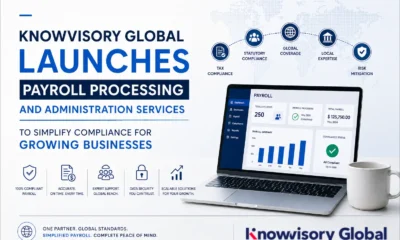
KnowVisory Global Launches Payroll Processing and Administration Services to Simplify Compliance for Growing Businesses
-

 Bengaluru8 months ago
Abercrombie & Fitch Enters India’s GCC Landscape with Bengaluru Launch
-

 Business8 months ago
GCC in Coimbatore: Why It’s the Next Big Hub for Global Capability Centers