
Finance
InvoiceCloud Expands Hyderabad GCC, Plans to Hire 150 Experts to Drive Fintech Innovation


InvoiceCloud is another fintech player that is taking advantage of the rapidly growing Global Capability Center (GCC) in India.
The US-based digital payments company is strengthening its India presence by hiring 150 skilled professionals for its Hyderabad GCC — showcasing the increasing relevance of the country in fintech.
Hyderabad GCC Becomes a Strategic Growth Hub
InvoiceCloud’s expansion in Hyderabad is not just about increasing the number of employees, it’s about creating a high-impact global delivery and innovation center.
The Hyderabad GCC is expected to critically enable:
- Global product development
- Digital payments
- Customer engagement technology
With the GCC positioned as a key operational and innovation hub in the Global Strategy of InvoiceCloud, India is emerging as a crucial player. ([GCC RISE][1])
150 New Roles Focused on High-Value Capabilities
The new hiring will concentrate on technology and product-driven roles such as:
- Engineers in AI and machine learning
- Engineers in Software and Platforms
- Experts in Product and Cloud
- Infrastructure and site reliability
The absence of support functions in the roles listed is indicative of a considerable shift — GCCs are now expected to build core digital capabilities. ([Indeed India][2])
AI and Digital Payments at the Core
InvoiceCloud operates in the digital billing and payment space, providing bill payment solutions that are cloud-based for utilities, governments, and insurance.
The Hyderabad GCC will focus on:
- Automation of payments using AI
- Platforms for enhanced intelligent customer experiences
- Financial systems that are SaaS-based and scalable
The company is already investing in AI-based payment solutions, and further strengthens the importance of its India center in global product development. ([GCC RISE][1])
Why GCC Investments in Hyderabad are Not Slowing Down
The expansion of InvoiceCloud in Hyderabad is indicative of the following:
1. Fintech and tech talent abundance
Hyderabad easily enables access to AI and engineering professionals.
2. Established GCC system
The city is home to global capability centers in various industries, establishing itself as a reliable center.
3. Balance of cost and value
The increase in value with the efficient use of resources is a benefit to the company.
4. Environment Friendly to Innovation
Hyderabad is seen as a growing product and engineering hub, rather than just a delivery center. ([Talentiser][3])
Leadership and Expansion Strategy
To aid in this growth, InvoiceCloud has also enhanced its leadership in India by installing a dedicated India site leader, who will focus on:
- Operational scaling
- Formation of high-performance teams
- Innovation driving from the GCC
This indicates a methodical design to convert the India center to a global capability powerhouse. ([GCC RISE][1])
Implications for the GCC Ecosystem
InvoiceCloud has further strengthened, and irrationally, the greater GCC core trends:
✔ Product and engineering hubs are the emerging focus for GCCs
✔ The innovation of AI and fintech has relocated to India
✔ The value of hires is concentrated on high-skill, high-impact roles
✔ Hyderabad is cementing its place as a premier GCC location
Conclusion
InvoiceCloud’s recruitment drive is a clear signal of the GCC evolution from expansion to the next phase.
From AI innovation and digital payments,
India is no longer an offshore support function to the global operations —
it is constructing and energizing them.
The signal is clear:
GCCs are evolving into global innovation engines,
and InvoiceCloud is one of the frontrunners in this evolution from Hyderabad.a

The role of India’s Global Capability Centres (GCCs) is changing rapidly. What once began as a model focused primarily on cost efficiency and back-office delivery is increasingly becoming a strategic engine for technology, transformation and business growth.
The Magnum Ice Cream Company’s Global Business Services (GBS) operation in Pune is an example of this shift.
Following Magnum’s separation from Unilever, the company is building its India GBS with a much broader ambition: not simply to provide support to global teams, but to actively participate in shaping how the business operates.
From GCC to Global Business Solutions
For Abhishek Mendiratta, Director and India GBS Head at The Magnum Ice Cream Company, the distinction between a traditional GCC and a GBS is important.
The Pune operation is being positioned as a business partner that helps determine how Magnum should operate, rather than as a team executing processes defined elsewhere.
This includes decisions around the technology stack, ERP architecture and operating processes.
One of the major initiatives is Magnum’s move towards SAP S/4HANA. The India GBS is involved not only in implementing the ERP platform but also in helping shape the broader technology ecosystem around it.
The organisation is also developing capabilities across supply chain, finance, marketing and sales.
That changes the fundamental question for the centre.
Instead of asking, “What work can we move to India?”, the focus becomes “What business outcomes can India help us create?”
Technology Is Becoming a Business Function
The transformation of Magnum’s India GBS reflects a wider evolution taking place across India’s GCC ecosystem.
Technology is no longer operating as a separate support function. It is increasingly embedded in business strategy.
At Magnum, the GBS is expected to participate in defining how technology can replace manual intervention, connect business functions and create a more integrated operating environment.
This approach gives the India team greater visibility into business decisions.
It also creates a stronger case for the GBS to have a seat at the leadership table.
As Mendiratta puts it, the organisation needs to be seen as a value creator rather than simply a backend operation.
The Real Talent Challenge: Technology + Domain Expertise
One of the biggest challenges facing this new generation of GBS organisations is talent.
India has no shortage of technology professionals with expertise in AI, analytics, SQL, data engineering and other digital technologies.
But technology skills alone are not enough.
The bigger advantage comes from combining technical capabilities with deep understanding of the business.
For example, an AI specialist who understands supply-chain operations can potentially create far more business value than someone who only understands the technology.
This is why Magnum is looking at a combination of technology specialists and domain experts rather than expecting every employee to possess every skill.
The objective is to build teams where technology expertise and business knowledge complement each other.
Reskilling Existing Employees
Another important part of Magnum’s strategy is reskilling its existing workforce.
Several employees joining the standalone organisation bring significant experience from their years in the ice cream business. That institutional knowledge is valuable.
Rather than replacing that knowledge with new technology talent, the strategy is to combine both.
Employees who understand Magnum’s business can be reskilled on newer technologies, tools and digital capabilities.
This creates an important competitive advantage.
The company does not have to choose between domain knowledge and technology expertise. It can build both within the same workforce.
For GCC leaders, this could become increasingly important as AI changes job roles and organisations need employees who understand both the technology and the business problems it is designed to solve.
Gen Z and the New Leadership Model
The transformation is not only about technology. It is also about culture.
Mendiratta highlights the importance of moving away from command-and-control leadership, particularly when managing younger employees.
For Gen Z talent, empowerment and autonomy can be as important as compensation and career progression.
Instead of dictating every decision, leaders increasingly need to create an environment where employees can make decisions, experiment and take ownership.
This is particularly relevant for GBS organisations that want to attract technology and innovation talent.
A centre cannot become an innovation hub if employees have to wait for multiple layers of approval before acting.
India’s GCC Evolution Is Moving Up the Value Chain
Magnum’s Pune GBS is part of a much broader trend across India’s GCC landscape.
Companies are increasingly establishing Indian centres not simply because India offers a large and cost-effective talent pool, but because the country offers access to technology expertise, domain talent, engineering capabilities and increasingly strategic leadership.
Recent GCC developments across India point in the same direction, with centres taking greater responsibility for AI, product development, engineering, enterprise transformation and global business outcomes.
This means the next competitive advantage for GCCs may not be the size of their workforce.
It may be the level of ownership they have over global business outcomes.
The Six-Month Mindset
Perhaps the most interesting element of Magnum’s approach is its focus on the near term.
Rather than defining the organisation primarily through a three- or five-year vision, Mendiratta argues that the pace of technological change makes six months a more meaningful planning horizon.
That mindset reflects the reality facing modern GBS organisations.
AI capabilities are evolving rapidly. Enterprise technology architectures are changing. Employee expectations are shifting. Business models are becoming more digital.
A long-term strategy is still important, but organisations need the ability to continuously adapt that strategy.
What Magnum’s Model Signals for India’s GCCs
The evolution of Magnum’s Pune GBS highlights five important lessons for the broader GCC ecosystem:
1. Move beyond cost arbitrage.
India’s value proposition is increasingly about expertise, innovation and business impact.
2. Combine domain with technology.
AI and digital skills become significantly more valuable when combined with deep business knowledge.
3. Reskill before replacing.
Existing employees can become powerful digital talent when their domain expertise is combined with new technology capabilities.
4. Give India decision-making authority.
A centre cannot become strategic if it only executes decisions made elsewhere.
5. Measure business outcomes, not just service delivery.
The strongest GBS organisations will be judged by the value they create for the global business.
The Bigger Picture
Magnum’s India GBS is being built at an interesting moment in the evolution of global capability centres.
The old model was simple: move work to India, improve efficiency and reduce costs.
The emerging model is fundamentally different.
Build capability in India. Give it ownership. Combine technology with domain expertise. And make it responsible for business outcomes.
For Magnum, the ambition is clear: Pune should not simply be the place where global work gets done.
It should be a place where the business is designed, transformed and improved.
And that may ultimately be the difference between an India GBS that supports the business and one that helps shape its future.

In early days, most founders tend to manage business finances on their own. They approve invoices, track expenses, and keep an eye on cash flow yourself.
But as your business grows, so does the complexity of managing your finances.
The challenge isn’t deciding when to hire your first finance professional – it’s understanding what kind of financial support your business actually needs.
Hiring the wrong person too early (or too late) can lead to inaccurate reporting, poor financial decisions, and unnecessary costs.
Here’s how to hire the right finance professionals for your business needs.
Start by Identifying the Problem
Before creating a job description, ask yourself:
- Are my books falling behind?
- Am I struggling to understand cash flow?
- Am I making important business decisions without reliable financial data?
- Are investors or lenders asking for reports I can’t easily produce?
Your answers will determine the type of finance professional your business needs.
Understanding the Different Finance Roles
Different finance professionals solve different business challenges.
| Role | Primary Responsibility | Best Time to Hire |
| Bookkeeper | Records daily transactions, reconciles accounts, manages accounts payable and receivable | As soon as your business has regular financial transactions |
| Controller | Oversees accounting operations, month-end close, financial reporting, and compliance | When accounting becomes more complex and requires stronger controls |
| FP&A Professional | Builds budgets, forecasts, and financial models to support planning | When you need better visibility into future business performance |
| Fractional CFO | Provides strategic financial leadership, fundraising support, and business advice | During periods of rapid growth, fundraising, or major business decisions |
When Should You Hire Each One?
Hire a Bookkeeper Early
If your business has regular customer payments, vendor bills, payroll, or bank transactions, accurate bookkeeping is essential.
Many startups choose to outsource bookkeeping rather than hire a full-time employee, making it a cost-effective way to maintain accurate financial records from the beginning.
Bring in a Controller as Complexity Grows
As your business grows, so does the complexity of your accounting. Managing multiple revenue streams, keeping up with month-end close, maintaining consistent financial reporting, and preparing for audits or investor due diligence require more than basic bookkeeping. This is when you should consider hiring a financial controller.
A controller oversees your accounting operations, strengthens internal controls, ensures compliance, and establishes efficient financial processes that keep your business running smoothly as it scales.
Add FP&A Support When Planning Becomes Critical
Understanding what happened last month is important, but knowing what is likely to happen next quarter is even more valuable.
An FP&A professional develops budgets, forecasts cash flow, builds financial models, and analyzes different business scenarios to help leadership make informed decisions. If you’re making hiring, expansion, or investment decisions based more on instinct than financial data, it’s a strong indication that your business could benefit from dedicated FP&A support.
Consider a Fractional CFO for Strategic Growth
As your business enters a growth phase, financial decisions become increasingly strategic. Whether you’re raising capital, expanding into new markets, improving profitability, or planning for long-term growth, a Fractional CFO provides the financial leadership needed to navigate these milestones.
Unlike a bookkeeper or controller, who focus on financial accuracy and operations, a Fractional CFO helps shape business strategy by providing insights into cash flow, pricing, fundraising, board reporting, and long-term financial planning. Their role is not just to report the numbers but to help leadership use those numbers to make confident business decisions.
A Typical Growth Path
Most businesses follow a similar progression:
- Early Stage: Founder + outsourced bookkeeping
- Growing Business: Bookkeeper + Controller
- Scaling Business: Add FP&A support
- Expansion Stage: Fractional or full-time CFO
While every business is different, building your finance function in this order helps create a solid financial foundation before adding strategic leadership.
Build Your Finance Team with Purpose
Your first finance hire shouldn’t be based solely on revenue or company size. Instead, it should be based on the challenges your business is facing today and the goals you’re working toward tomorrow.
Start with accurate financial records, build strong accounting processes, and then invest in forecasting and strategic financial leadership as your business grows.
Whether you need outsourced bookkeeping, financial planning and analysis (FP&A), or strategic CFO guidance, the right finance support can help your business scale with confidence.

Every founder wears a dozen hats in the early days. You’re closing deals, managing operations, sending invoices, reconciling the bank account, running payroll, and making sense of your financial reports.
In the early stages, transaction volumes are low, the business is simple, and staying close to the numbers is easy. But as your business grows, so does financial complexity.
What worked when you had a handful of clients starts to break down once you have dozens. More customers, more employees, more vendors, more compliance requirements — it all adds up to a level of financial complexity that a DIY approach was never built to handle.
The real question isn’t whether you can keep managing your own finances. It’s whether you should.
Here are five signs your business has outgrown DIY finance—and why building a stronger finance function through outsourced accounting or in-house hiring may be the smartest investment you make this year.
- You’re Spending More Time Managing Finances Than Growing Your Business
Every hour spent reconciling transactions, chasing invoices, running payroll, or sorting through receipts is an hour you didn’t spend growing your company. As the business expands, these tasks don’t shrink — they multiply. What used to take a few hours a month can quietly eat up entire days.
None of this work is unimportant. It’s just not the best use of a founder’s time. That time is worth far more spent on customers, product, new markets, and the decisions only you can make. Growth comes from focusing on high-value work, not administrative upkeep.
- Your Financial Reports Arrive Too Late to Support Decisions
A growing business needs timely numbers for accurate and profitable decision making. Can you afford to bring on another hire? Is it time to invest in new equipment? Is your pricing still working? Which customers are actually driving your margins?
Without accurate, current financial data, you end up answering those questions with guesswork instead of facts. Delayed bookkeeping means delayed reporting, and delayed reporting means delayed decisions. Financial visibility isn’t just about knowing what happened last month — it’s about having the confidence to act today.
- Cash Flow is Getting Harder to Manage
Revenue is climbing, but so is everything else. Payroll grows. Vendor bills pile up. Customers pay on their own schedule, not yours. Taxes get more complicated. Without consistent bookkeeping and someone actively watching the numbers, cash flow surprises start creeping in.
It’s a common trap: a business looks profitable on paper but still runs into cash shortages, simply because no one has a clear, current picture of receivables, payables, and what’s coming due. Once cash flow becomes unpredictable, growth becomes a lot harder to steer.
- Small Financial Errors are Becoming Costly Problems
DIY finance rarely fails all at once. A missed invoice here, an unreconciled account there, an expense filed under the wrong category, a payroll filing that goes out a day late, a deduction nobody caught.
On their own, these look minor. Add them up over a year, though, and they chip away at the accuracy of your reports, raise your compliance risk, and eat up time you’ll spend fixing mistakes that shouldn’t have happened in the first place. Clean books aren’t just a compliance checkbox — they’re the foundation everything else gets decided on.
- Your Financial Processes Haven’t Kept Pace with Growth
One of the clearest signs you’ve outgrown DIY finance is when the business gets more sophisticated but the finance function stays exactly the same. You’re still living in spreadsheets. Approvals happen over email. Financial data is scattered across different systems. Month-end close takes a little longer every month, and your accountant always seems to be waiting on something.
Growth doesn’t cause these problems — it just exposes ones that were already there. As transaction volume and complexity rise, you need standardized processes, connected technology, and dedicated financial support to keep pace.
What Successful Businesses Do Instead
Successful businesses recognize that finance is no longer just an administrative function—it’s a strategic driver of growth. Rather than relying on reactive processes, they invest in systems, technology, and expertise that provide timely financial visibility, stronger controls, and the capacity to scale confidently. They build their finance function around:
- Cloud accounting technology
- Standardized financial processes
- Real-time reporting and dashboards
- Strong internal controls and compliance
- Experienced accounting professionals
Rather than hiring out a full in-house finance team from day one, many growing companies choose to bring in outsourced accounting support instead. The right partner gives you the expertise, capacity, and technology know-how to handle bookkeeping, payroll, accounts payable and receivable, reconciliations, reporting, and month-end close — all while fitting neatly into the systems you already use. The outcome is a finance function that’s agile enough to support growth instead of slowing it down.
Build a Finance Function That Grows with You
Delegating your financial operations isn’t about giving up control. It’s about gaining the capacity, expertise, and visibility you need to make better decisions and support sustainable growth.. As your business grows, your finance function should stop being an administrative chore and start being a strategic advantage.
The question was never whether your business has grown. It’s whether your finance function has grown with it.
Ready to scale with confidence? Partner with experts and build a finance function designed for your next stage of growth.
-

 Business6 months ago
S&P Global Expands India Footprint with New Gurugram Hub
-
 Politics7 months ago
Maximus Expands Hyderabad GCC: Strengthening India’s Role in Global Healthcare & Public Sector Operations
-
 Press Release6 months ago
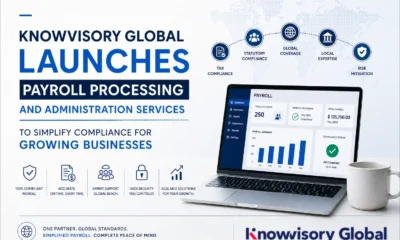
KnowVisory Global Launches Payroll Processing and Administration Services to Simplify Compliance for Growing Businesses
-

 Bengaluru6 months ago
Abercrombie & Fitch Enters India’s GCC Landscape with Bengaluru Launch
-

 Bengaluru2 months ago
DePuy Synthes Selects Bengaluru for New GCC, Targets 500 Hires
-

 Bengaluru5 months ago
Commonwealth Bank Appoints Shubha Iyer as CEO of CommBank India to Strengthen GCC and Digital Transformation Strategy
-

 New GCC4 months ago
Generac Launches First India Global Capability Center in Pune
-

 Business7 months ago
GCC in Coimbatore: Why It’s the Next Big Hub for Global Capability Centers