
Entertainment
Jaipur Become India’s Next GCC Hub? Rajasthan Bets on Finance & Tourism Edge


India’s Global Capability Center (GCC) expansion is no longer limited to metro cities — and Jaipur is emerging as a serious contender.
Rajasthan is now positioning its capital as a future-ready GCC destination, built on a unique combination of finance talent, tourism strength, and lifestyle infrastructure.
A New GCC Vision for Jaipur
At the core of this ambition is a large-scale development project near Jaipur airport — designed to create a dedicated GCC ecosystem.
Key highlights include:
- Planned GCC towers with ~1.7 million sq. ft. space
- Expansion potential with additional 2 million sq. ft. workspace
- A “live, work, play” environment for global professionals
This is not just infrastructure — it’s a positioning strategy to attract global enterprises.
Beyond IT: A Sector-Focused GCC Strategy
Unlike traditional GCC hubs that focus broadly on IT services, Rajasthan is taking a more targeted approach.
The state aims to attract GCCs in:
- Financial services
- Technology and analytics
- Hospitality and tourism-linked operations
Industry experts emphasize that Jaipur should double down on its strengths, rather than compete directly with Bengaluru or Hyderabad across all sectors.
Leveraging Tourism as a Talent Advantage
One of the most unique aspects of Rajasthan’s strategy is its tourism-driven ecosystem.
The GCC model here integrates:
- Hotels and residences
- Cultural hubs and museums
- Lifestyle infrastructure to attract global talent
This creates a differentiated value proposition:
👉 Not just a workplace
👉 But a global living destination for talent
Additionally, there is a push to reskill hospitality talent with AI and digital capabilities, aligning with the evolving needs of GCCs.
Policy Push & Ecosystem Development
Rajasthan is backing this vision with aggressive policy support:
- Competitive GCC incentives
- Transparent land allocation at subsidized rates
- Active collaboration with private developers
This reflects a broader shift where state governments are actively competing to attract GCC investments.
Challenges That Need to Be Solved
Despite the strong vision, there are critical gaps that need attention:
- Limited international flight connectivity
- Urban mobility and commuting infrastructure
- Need for higher-end global talent readiness
For global enterprises, these factors play a decisive role in location strategy.
What This Means for the GCC Ecosystem
Jaipur’s push highlights key shifts in the GCC landscape:
1. Tier-2 cities are entering the GCC race
Companies are exploring alternatives beyond traditional hubs.
2. Lifestyle is becoming a differentiator
Talent attraction now depends on quality of life, not just salaries.
3. Sector specialization is the future
Cities will win by building domain-led GCC ecosystems, not generic capabilities.
4. GCCs are moving toward value creation
The focus is shifting from scale to high-value, knowledge-driven work.
Final Take
Rajasthan’s GCC strategy is not about replicating Bengaluru —
it’s about building a differentiated model.
By combining:
- Finance talent
- Tourism ecosystem
- Integrated infrastructure
Jaipur has the potential to emerge as a niche GCC hub for the future.
The real question is:
Can emerging cities like Jaipur redefine the GCC map —
or will metro dominance continue?
Business
Shiney Prasad Joins Aon to Lead Global Capability Centers: A Strategic Move in the Evolving GCC Landscape

In a significant leadership development within the Global Capability Center (GCC) ecosystem, Shiney Prasad has taken on the role of Head of Global Capability Centers at Aon. This appointment reflects a broader shift in how enterprises are reimagining GCCs—not as support units, but as strategic engines of innovation and value creation.
A Leadership Move Aligned with GCC Evolution
Aon’s decision to bring in Shiney Prasad comes at a time when GCCs are rapidly transitioning from cost-efficiency hubs to high-impact global delivery centers. His role is expected to strengthen Aon’s ability to integrate global talent, analytics, and domain expertise into a cohesive operating model.
The company’s GCCs already play a critical role in enabling business outcomes by connecting capabilities across geographies. With Shiney at the helm, the focus will likely intensify on scaling innovation and delivering more integrated, client-centric solutions.
Driving Innovation Through Integrated Capabilities
Aon has been actively aligning its operations under a unified strategy, where GCCs are positioned as key enablers of transformation. Shiney Prasad’s leadership is expected to accelerate this vision by:
- Enhancing cross-functional collaboration across global teams
- Leveraging data and analytics for smarter decision-making
- Strengthening operational transformation initiatives
- Building scalable, future-ready delivery models
This approach aligns with the broader trend where GCCs are no longer judged by operational efficiency alone, but by their contribution to enterprise-wide innovation and strategic outcomes.
A Leader with Deep Industry and Transformation Expertise
Shiney Prasad brings decades of experience across insurance, consulting, and global operations. His career spans leadership roles in organizations such as Guardian Life, Sun Life, EY, and other multinational firms, where he has led large-scale transformation, digital initiatives, and GCC operations.
His expertise in areas like operational transformation, digital strategy, and enterprise scaling makes him well-positioned to lead Aon’s GCC strategy in a highly competitive and evolving landscape.
What This Means for the GCC Ecosystem
This appointment signals a larger industry shift:
- GCC leadership roles are becoming more strategic and transformation-focused
- Companies are investing in leaders with cross-domain expertise
- Innovation, AI, and analytics are becoming core to GCC mandates
- India continues to strengthen its position as a global GCC hub
Aon’s move reinforces the idea that the future of GCCs lies in their ability to drive business impact—not just support it.
The Road Ahead
As GCCs continue to evolve into innovation hubs, leadership will play a defining role in shaping their trajectory. Shiney Prasad’s appointment is a clear indicator that organizations are prioritizing strategic leadership to unlock the full potential of their global capability networks.
For Aon, this marks the beginning of a new chapter—one where GCCs are not just operational backbones but critical drivers of growth, innovation, and competitive advantage.

A Strategic Expansion into India’s Innovation Ecosystem
Global retail major Abercrombie & Fitch has officially entered India’s Global Capability Center (GCC) ecosystem with the launch of its new center in Bengaluru. This move marks a significant milestone in the brand’s global transformation journey, as it increasingly leans into digital, analytics, and technology-led operations.
India continues to attract global enterprises looking to build high-value capability hubs—not just for cost optimization, but for innovation, agility, and access to world-class talent.
Why Bengaluru Continues to Dominate GCC Expansion
Bengaluru has emerged as the epicenter for GCC growth in India, and Abercrombie & Fitch’s decision reinforces this trend. The city offers a unique combination of:
- Deep talent pools in engineering, analytics, and digital commerce
- A mature startup and innovation ecosystem
- Strong infrastructure for global operations
- Proven success in hosting Fortune 500 GCCs
For global retailers undergoing digital transformation, Bengaluru provides the ideal environment to build scalable, tech-driven operations.
Inside Abercrombie & Fitch’s GCC Vision
The newly launched GCC is expected to play a critical role in supporting the company’s global business functions. Rather than operating as a back-office unit, the center is being positioned as a strategic hub focused on:
- Advanced analytics and data science
- Digital product development
- IT and enterprise technology support
- Customer experience optimization
This reflects a broader shift in how GCCs are being designed—moving away from transactional support toward value creation and innovation.
GCCs: From Cost Efficiency to Strategic Value Creation
Abercrombie & Fitch’s entry into India’s GCC ecosystem highlights a larger industry trend. Today’s GCCs are no longer just cost-saving centers; they are:
- Innovation engines driving digital transformation
- Centers of excellence for AI, data, and automation
- Strategic partners in global decision-making
Retail and consumer brands, in particular, are leveraging GCCs to reimagine customer engagement, supply chains, and omnichannel experiences.
Talent as the Core Growth Driver
One of the biggest drivers behind this expansion is India’s unmatched talent ecosystem. Companies like Abercrombie & Fitch are tapping into:
- Skilled professionals in AI, ML, and data analytics
- Digital commerce and product engineering experts
- Agile teams capable of working across global time zones
This talent advantage enables organizations to accelerate innovation while maintaining operational efficiency.
What This Means for India’s GCC Ecosystem
The entry of global retail brands into the GCC space signals a diversification of industries adopting this model. While sectors like BFSI and technology have traditionally led GCC growth, retail and lifestyle brands are now:
- Investing in digital-first capabilities
- Building global tech hubs in India
- Strengthening their direct-to-consumer strategies
This evolution will further solidify India’s position as a global GCC powerhouse.
The Road Ahead: Retail GCCs on the Rise
As consumer expectations evolve and digital becomes central to retail success, more global brands are expected to follow suit. GCCs will increasingly focus on:
- Personalization through data and AI
- Seamless omnichannel experiences
- Supply chain intelligence and automation
Abercrombie & Fitch’s Bengaluru GCC is not just an expansion—it’s a signal of where the future of retail operations is headed.
Conclusion
The launch of Abercrombie & Fitch’s GCC in Bengaluru reflects a broader shift in how global companies view India—not just as a cost-efficient destination, but as a strategic innovation partner.
As GCCs continue to evolve into high-impact business enablers, India’s role in shaping global enterprise transformation will only grow stronger.
Data Source : Link
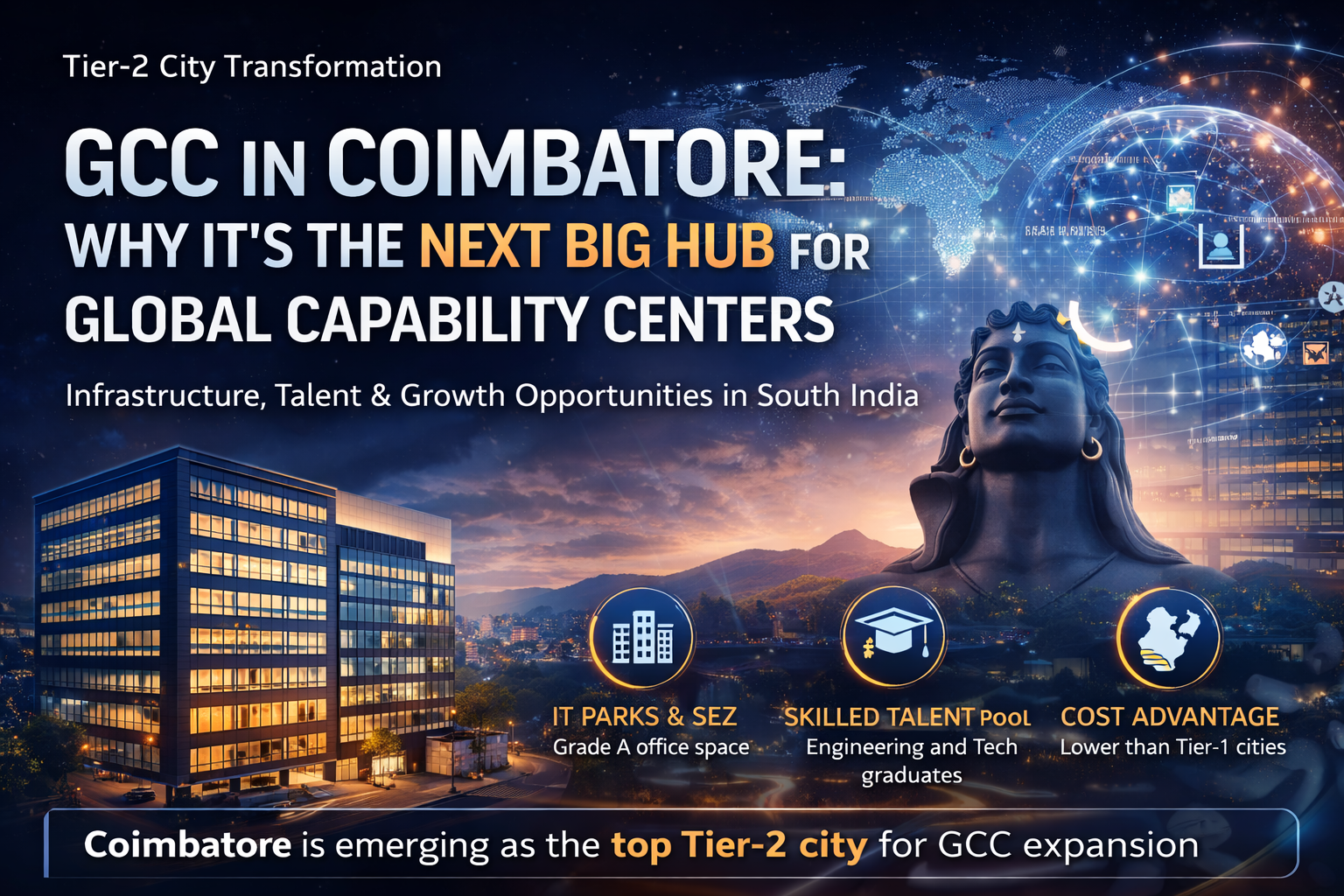
India’s Global Capability Center (GCC) ecosystem is undergoing a structural transformation. While cities like Bengaluru, Hyderabad, and Pune have traditionally dominated the landscape, Tier-2 cities are rapidly emerging as the next frontier. Among them, Coimbatore stands out as a high-potential destination for GCC expansion.
With its strong industrial base, growing IT ecosystem, cost advantages, and talent availability, Coimbatore is uniquely positioned to become a strategic GCC hub for global enterprises.
This article outlines a comprehensive GCC development plan for Coimbatore, covering infrastructure, talent strategy, policy support, and long-term growth opportunities.
Why Coimbatore? The Strategic Advantage
Coimbatore is not just another Tier-2 city—it is a hybrid economic zone combining manufacturing strength with IT and services growth.
Key Advantages:
- Strong engineering and manufacturing ecosystem
- Growing IT and software services presence
- Lower operational and real estate costs (30–50% lower than Tier-1 cities)
- Access to skilled graduates from top institutions
- Improved connectivity and infrastructure
This combination creates a cost-to-capability advantage, making Coimbatore highly attractive for GCCs.
The Rising Role of Tier-2 Cities in GCC Expansion
The GCC model is evolving beyond cost arbitrage.
Key Trends Driving Expansion:
- Talent saturation in Tier-1 cities
- Rising employee costs and attrition
- Demand for distributed global delivery models
- Government push for regional economic development
Coimbatore fits perfectly into this shift, offering scalability without the constraints of metro cities.
Infrastructure Development Plan
A successful GCC ecosystem depends heavily on infrastructure readiness.
1. IT Parks & SEZ Expansion
- Expansion of ELCOT IT parks
- Development of new Grade A office spaces
- Plug-and-play infrastructure for faster GCC setup
2. Connectivity Enhancements
- Upgrading Coimbatore International Airport
- Improved road connectivity (NH corridors)
- Better intra-city transport systems
3. Smart City Integration
- Digital infrastructure (5G readiness)
- Smart utilities and urban planning
- Sustainable energy adoption
Talent Development Strategy
Talent is the backbone of any GCC.
1. Academic-Industry Collaboration
- Partnerships with engineering colleges
- Curriculum aligned with GCC requirements
- Internship and apprenticeship programs
2. Skill Development Programs
- Focus on AI, data analytics, cloud, and cybersecurity
- Government-supported skilling initiatives
- Certification-driven learning pathways
3. Talent Retention Strategy
- Competitive salaries with lower cost of living
- Better work-life balance compared to metros
- Strong local hiring ecosystem
Technology & Innovation Focus
Modern GCCs are innovation hubs—not just delivery centers.
Key Focus Areas:
- Artificial Intelligence & Machine Learning
- Robotic Process Automation (RPA)
- Fintech and SaaS product development
- IoT and Industry 4.0 (leveraging Coimbatore’s manufacturing base)
Innovation Enablement:
- Setting up innovation labs and incubators
- Encouraging startup-GCC collaboration
- Promoting R&D investments
Government & Policy Support
Government backing is critical for GCC growth.
Key Initiatives:
- Tax incentives for IT and GCC companies
- Simplified regulatory frameworks
- Single-window clearance systems
- Infrastructure subsidies
Tamil Nadu government’s focus on decentralized IT growth positions Coimbatore as a priority city.
Industry Opportunities for GCCs in Coimbatore
Coimbatore’s strengths align well with multiple industries:
1. Manufacturing & Engineering GCCs
- Supply chain optimization
- Product engineering
- Industrial automation
2. BFSI & Fintech GCCs
- Risk analytics
- Payment systems
- Compliance operations
3. Healthcare & MedTech
- Health data analytics
- Telemedicine platforms
- Medical device R&D
4. SaaS & IT Services
- Product development
- Customer success operations
- Global support centers
Economic Impact of GCC Growth
A well-executed GCC strategy can transform Coimbatore’s economy.
Expected Outcomes:
- Job creation (10,000+ high-value roles in 5–7 years)
- Increase in real estate demand
- Growth of ancillary industries
- Rise in startup ecosystem
GCC Setup Roadmap for Companies
For enterprises planning a GCC in Coimbatore:
Phase 1: Market Entry
- Feasibility study
- Location selection
- Talent mapping
Phase 2: Setup
- Office infrastructure
- Hiring core leadership
- Initial team onboarding
Phase 3: Scale
- Expand functions
- Build innovation capabilities
- Integrate with global operations
Challenges & Mitigation Strategies
Challenges:
- Limited global exposure compared to Tier-1 cities
- Initial talent readiness gaps
- Perception as a non-metro location
Solutions:
- Strong employer branding
- Training and upskilling programs
- Strategic partnerships with universities
Future Outlook
Coimbatore is on track to become a top Tier-2 GCC destination in India.
With the right investments in:
- Infrastructure
- Talent
- Policy
The city can evolve into a global hub for innovation, technology, and operations.
Final Take
The GCC opportunity in Coimbatore is not just about expansion—it’s about strategic transformation.
Companies that invest early will gain:
- Cost advantages
- Talent access
- Long-term scalability
The next wave of GCC growth will not be limited to metros.
It will be built in cities like Coimbatore.
-

 Business6 months ago
S&P Global Expands India Footprint with New Gurugram Hub
-

 Press Release6 months ago
KnowVisory Global Launches Payroll Processing and Administration Services to Simplify Compliance for Growing Businesses
-
 Politics7 months ago
Maximus Expands Hyderabad GCC: Strengthening India’s Role in Global Healthcare & Public Sector Operations
-

 Bengaluru6 months ago
Abercrombie & Fitch Enters India’s GCC Landscape with Bengaluru Launch
-

 Bengaluru2 months ago
DePuy Synthes Selects Bengaluru for New GCC, Targets 500 Hires
-

 Bengaluru5 months ago
Commonwealth Bank Appoints Shubha Iyer as CEO of CommBank India to Strengthen GCC and Digital Transformation Strategy
-
 New GCC4 months ago
Generac Launches First India Global Capability Center in Pune
-

 Business7 months ago
GCC in Coimbatore: Why It’s the Next Big Hub for Global Capability Centers